Ch. 19 - Amines
Wade - Organic Chemistry 9th Edition
Wade9th EditionOrganic ChemistryISBN: 9780135213728Not the one you use?Change textbook
Chapter 19, Problem 26a,b,c

Show how to synthesize the following amines from the indicated starting materials by reductive amination.
(a) benzylmethylamine from benzaldehyde
(b) N-benzylpiperidine from piperidine
(c) N-cyclohexylaniline from cyclohexanone

Verified step by step guidance
1
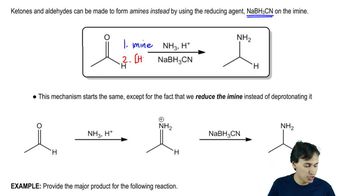
Step 1: Understand the concept of reductive amination. Reductive amination is a reaction where an aldehyde or ketone reacts with an amine to form an imine intermediate, which is then reduced to form an amine. The reduction step typically uses a reducing agent like sodium cyanoborohydride (NaBH3CN) or hydrogen with a catalyst.
Step 2: For part (a), benzylmethylamine from benzaldehyde: Start with benzaldehyde (C6H5CHO) as the starting material. React benzaldehyde with methylamine (CH3NH2) to form an imine intermediate. The imine has the structure C6H5CH=NHCH3. Then, reduce the imine using a reducing agent like NaBH3CN to form benzylmethylamine (C6H5CH2NHCH3).
Step 3: For part (b), N-benzylpiperidine from piperidine: Start with piperidine (C5H11N) as the amine and benzaldehyde (C6H5CHO) as the aldehyde. React benzaldehyde with piperidine to form an imine intermediate with the structure C6H5CH=N(C5H10). Reduce this imine using NaBH3CN to form N-benzylpiperidine (C6H5CH2N(C5H10)).
Step 4: For part (c), N-cyclohexylaniline from cyclohexanone: Start with cyclohexanone (C6H10O) as the ketone and aniline (C6H5NH2) as the amine. React cyclohexanone with aniline to form an imine intermediate with the structure C6H10=NC6H5. Reduce this imine using NaBH3CN to form N-cyclohexylaniline (C6H11NHC6H5).
Step 5: Summarize the general process for reductive amination: (1) React the aldehyde or ketone with the amine to form an imine intermediate. (2) Use a mild reducing agent like NaBH3CN to selectively reduce the imine to the desired amine product. Ensure proper reaction conditions (e.g., pH control) to avoid side reactions.

Verified video answer for a similar problem:

This video solution was recommended by our tutors as helpful for the problem above.
Video duration:
8m
Was this helpful?

Key Concepts

Here are the essential concepts you must grasp in order to answer the question correctly.

Reductive Amination

Reductive amination is a chemical reaction that involves the conversion of a carbonyl compound (like an aldehyde or ketone) into an amine. This process typically includes the formation of an imine or enamine intermediate, which is then reduced to yield the desired amine. Common reducing agents used in this reaction include sodium cyanoborohydride or hydrogen in the presence of a catalyst.
Recommended video:
Guided course
07:12
Reductive Amination

Carbonyl Compounds

Carbonyl compounds, which include aldehydes and ketones, are characterized by the presence of a carbonyl group (C=O). In the context of reductive amination, these compounds serve as the starting materials that react with amines to form imines. Understanding the reactivity and properties of carbonyl compounds is crucial for predicting the outcomes of synthetic pathways involving amine formation.
Recommended video:
Guided course
01:40
Defining meso compounds.

Amine Structure and Reactivity

Amines are organic compounds derived from ammonia by replacing one or more hydrogen atoms with alkyl or aryl groups. Their structure influences their reactivity, particularly in nucleophilic reactions. In reductive amination, the nucleophilic nature of amines allows them to attack the electrophilic carbon of carbonyl compounds, leading to the formation of imine intermediates essential for synthesizing various amines.
Recommended video:
Guided course
07:12
Reductive Amination