


Ch. 19 - Amines
Wade - Organic Chemistry 9th Edition
Wade9th EditionOrganic ChemistryISBN: 9780135213728Not the one you use?Change textbook
Chapter 19, Problem 50a

Show how you can synthesize the following compounds starting with benzene, toluene, and alcohols containing no more than four carbon atoms as your organic starting materials. Assume that para is the major product (and separable from ortho) in ortho, para mixtures.
(a) pentan-1-amine

Verified step by step guidance
1
Step 1: Start with benzene as the base compound. To introduce an alkyl chain, perform a Friedel-Crafts alkylation using 1-chloropentane (C5H11Cl) and AlCl3 as the catalyst. This will yield pentylbenzene.
Step 2: To introduce an amino group (-NH2) onto the alkyl chain, first convert the terminal carbon of the pentyl chain into a functional group that can be further modified. Perform a bromination reaction using N-bromosuccinimide (NBS) and light (hv) to selectively brominate the benzylic position, forming 1-bromo-5-phenylpentane.
Step 3: Replace the bromine atom with an amino group by performing a nucleophilic substitution reaction (SN2). React 1-bromo-5-phenylpentane with excess ammonia (NH3) to yield pentan-1-amine.
Step 4: To ensure the para product is the major product in any intermediate steps involving substitution on the benzene ring, carefully control reaction conditions and use separation techniques to isolate the para isomer if necessary.
Step 5: Verify the structure of the final product, pentan-1-amine, using spectroscopic techniques such as NMR and IR to confirm the presence of the amine group and the correct carbon chain length.

Verified video answer for a similar problem:

This video solution was recommended by our tutors as helpful for the problem above.
Video duration:
2m
Was this helpful?

Key Concepts

Here are the essential concepts you must grasp in order to answer the question correctly.

Electrophilic Aromatic Substitution (EAS)

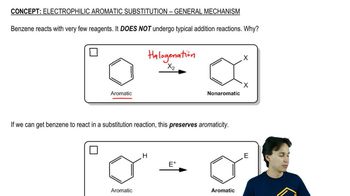
Electrophilic Aromatic Substitution is a fundamental reaction in organic chemistry where an electrophile replaces a hydrogen atom on an aromatic ring, such as benzene. This reaction is crucial for synthesizing various compounds from aromatic starting materials. Understanding the mechanism of EAS, including the formation of the sigma complex and the role of activating and deactivating groups, is essential for predicting the products of reactions involving benzene and its derivatives.
Recommended video:

Nucleophilic Substitution Reactions

Nucleophilic substitution reactions involve the replacement of a leaving group in a molecule with a nucleophile. In the context of synthesizing amines, this often involves the reaction of alkyl halides with nucleophiles like amines. Recognizing the difference between SN1 and SN2 mechanisms is important, as they dictate the reaction conditions and the stereochemistry of the products formed during the synthesis of pentan-1-amine.
Recommended video:
Guided course
01:47
Nucleophiles and Electrophiles can react in Substitution Reactions.

Functional Group Interconversion

Functional group interconversion refers to the transformation of one functional group into another within a molecule. This concept is vital for synthesizing complex organic compounds, as it allows chemists to modify existing structures to achieve desired functionalities. In the synthesis of pentan-1-amine, converting alcohols or aromatic compounds into amines through various reactions, such as reduction or substitution, exemplifies the importance of this concept in organic synthesis.
Recommended video:
Guided course
02:36
Identifying Functional Groups
Related Practice
Textbook Question

Several additional amine syntheses are effectively limited to making primary amines. The reduction of azides and nitro compounds and the Gabriel synthesis leave the carbon chain unchanged. Formation and reduction of a nitrile adds one carbon atom. Show how these amine syntheses can be used for the following conversions.

(c) 1-bromo-3-phenylheptane → 3-phenylheptan-1-amine

852
views
Textbook Question

Show how you can synthesize the following compounds starting with benzene, toluene, and alcohols containing no more than four carbon atoms as your organic starting materials. Assume that para is the major product (and separable from ortho) in ortho, para mixtures.

(d) N-benzylpropan-1-amine

619
views
Textbook Question

Show how you can synthesize the following compounds starting with benzene, toluene, and alcohols containing no more than four carbon atoms as your organic starting materials. Assume that para is the major product (and separable from ortho) in ortho, para mixtures.

(b) N-methylbutan-1-amine

401
views
Textbook Question

Show how you can synthesize the following tertiary amine three different ways, each using a different secondary amine and adding the final substituent by (b) acylation–reduction (3 ways).

1240
views
Textbook Question

Show how you can synthesize the following compounds starting with benzene, toluene, and alcohols containing no more than four carbon atoms as your organic starting materials. Assume that para is the major product (and separable from ortho) in ortho, para mixtures.

(c) N-ethyl-N-propylbutan-2-amine

638
views
Textbook Question

Show how you can synthesize the following tertiary amine three different ways, each using a different secondary amine and adding the final substituent by

(a) reductive amination (3 ways).

622
views