Ch. 19 - Amines
Wade - Organic Chemistry 9th Edition
Wade9th EditionOrganic ChemistryISBN: 9780135213728Not the one you use?Change textbook
Chapter 19, Problem 30d

Show how you would accomplish the following synthetic conversions.
(d) pentanoic acid → hexan-1-amine

Verified step by step guidance
1
Step 1: Convert pentanoic acid to pentanoyl chloride using thionyl chloride (SOCl₂). This reaction replaces the hydroxyl group (-OH) of the carboxylic acid with a chlorine atom, forming an acyl chloride.
Step 2: Perform a nucleophilic acyl substitution reaction by treating pentanoyl chloride with diazomethane (CH₂N₂). This introduces a methyl group to the carbonyl carbon, forming a methyl ketone (hexan-2-one).
Step 3: Reduce hexan-2-one to hexan-2-ol using a reducing agent such as sodium borohydride (NaBH₄). This step converts the ketone group to an alcohol group.
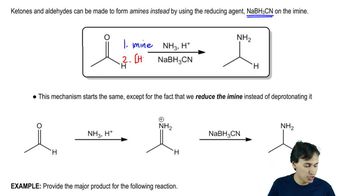
Step 4: Convert hexan-2-ol to hexan-1-amine by first oxidizing the alcohol to an aldehyde using PCC (pyridinium chlorochromate), followed by reductive amination using ammonia (NH₃) and a reducing agent like sodium cyanoborohydride (NaBH₃CN).
Step 5: Ensure the final product is hexan-1-amine by verifying the structure and functional group placement. The primary amine (-NH₂) should be attached to the terminal carbon of the hexane chain.

Verified video answer for a similar problem:

This video solution was recommended by our tutors as helpful for the problem above.
Video duration:
4m
Was this helpful?

Key Concepts

Here are the essential concepts you must grasp in order to answer the question correctly.

Carboxylic Acids

Carboxylic acids are organic compounds characterized by the presence of a carboxyl group (-COOH). They are known for their acidic properties and can undergo various reactions, including reduction and conversion to amines. In this context, pentanoic acid serves as the starting material for the synthesis of hexan-1-amine.
Recommended video:
Guided course
04:20
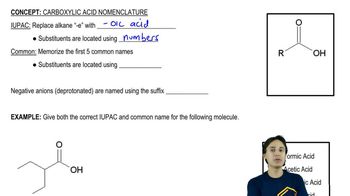
Carboxylic Acids Nomenclature

Reduction Reactions

Reduction reactions involve the gain of electrons or the decrease in oxidation state of a molecule. In organic chemistry, carboxylic acids can be reduced to primary alcohols or amines using reducing agents such as lithium aluminum hydride (LiAlH4). This step is crucial for converting pentanoic acid into hexan-1-amine.
Recommended video:
Guided course
07:12
Reductive Amination

Amine Synthesis

Amines are organic compounds derived from ammonia by replacing one or more hydrogen atoms with alkyl or aryl groups. The synthesis of hexan-1-amine from pentanoic acid involves the reduction of the carboxylic acid to an amine, which is a common transformation in organic synthesis. Understanding the mechanisms of amine formation is essential for this conversion.
Recommended video:
Guided course
07:12
Reductive Amination