Ch. 19 - Amines
Wade - Organic Chemistry 9th Edition
Wade9th EditionOrganic ChemistryISBN: 9780135213728Not the one you use?Change textbook
Chapter 19, Problem 25c

Show how you would convert aniline to the following compounds.
(c) 1,3,5-trimethylbenzene

Verified step by step guidance
1
Step 1: Begin with aniline (C₆H₅NH₂) as the starting material. The amino group (-NH₂) is an activating group and ortho/para-directing in electrophilic aromatic substitution reactions. However, for this transformation, the amino group must first be removed to allow for the introduction of methyl groups in a symmetrical 1,3,5 arrangement.
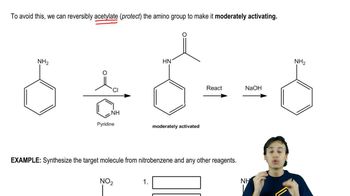
Step 2: Protect the amino group by converting it into an acetamide group. This can be achieved by reacting aniline with acetic anhydride (CH₃CO₂O) to form acetanilide (C₆H₅NHCOCH₃). This step reduces the reactivity of the amino group and prevents unwanted side reactions.
Step 3: Perform a nitration reaction on acetanilide to introduce nitro groups (-NO₂) at the meta positions relative to the acetamide group. Use a mixture of concentrated HNO₃ and H₂SO₄ to achieve this. The product will be 1,3,5-trinitrobenzene.
Step 4: Reduce the nitro groups to amine groups (-NH₂) using a reducing agent such as tin (Sn) and hydrochloric acid (HCl). This will yield 1,3,5-triaminobenzene.
Step 5: Perform a diazotization reaction on 1,3,5-triaminobenzene by treating it with sodium nitrite (NaNO₂) and HCl at 0°C to form diazonium salts. Then, replace the diazonium groups with methyl groups (-CH₃) using a Sandmeyer reaction with methyl iodide (CH₃I) and a copper catalyst. This will yield 1,3,5-trimethylbenzene as the final product.

Verified video answer for a similar problem:

This video solution was recommended by our tutors as helpful for the problem above.
Video duration:
8m
Was this helpful?

Key Concepts

Here are the essential concepts you must grasp in order to answer the question correctly.

Aniline Structure and Reactivity

Aniline is an aromatic amine with the formula C6H5NH2. Its amino group (-NH2) is a strong activating group for electrophilic aromatic substitution reactions, making the benzene ring more reactive towards electrophiles. Understanding the structure and reactivity of aniline is crucial for planning its transformation into more complex aromatic compounds.
Recommended video:
Guided course
05:15
Protection of Aniline Derivatives

Electrophilic Aromatic Substitution (EAS)

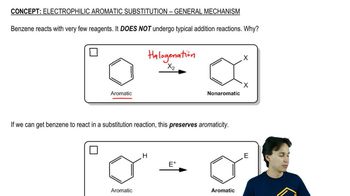
Electrophilic aromatic substitution is a fundamental reaction in organic chemistry where an electrophile replaces a hydrogen atom on an aromatic ring. This reaction is key to modifying the benzene ring of aniline to introduce additional substituents, such as methyl groups, which are necessary for synthesizing 1,3,5-trimethylbenzene.
Recommended video:

Friedel-Crafts Alkylation

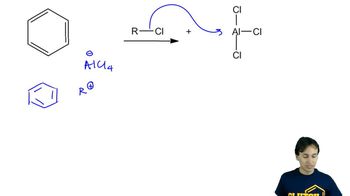
Friedel-Crafts alkylation is a specific type of electrophilic aromatic substitution that involves the introduction of alkyl groups onto an aromatic ring using alkyl halides and a Lewis acid catalyst. This reaction is essential for converting aniline into 1,3,5-trimethylbenzene by sequentially adding methyl groups to the benzene ring through controlled alkylation steps.
Recommended video:
Guided course
06:30
Friedel-Crafts Alkylation