Ch. 19 - Amines
Wade - Organic Chemistry 9th Edition
Wade9th EditionOrganic ChemistryISBN: 9780135213728Not the one you use?Change textbook
Chapter 19, Problem 19

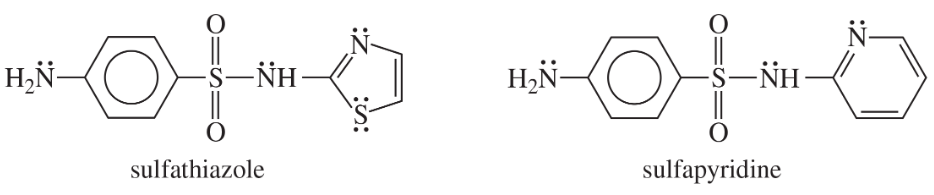
Show how you would use the same sulfonyl chloride as used in the sulfanilamide synthesis to make sulfathiazole and sulfapyridine.

Verified step by step guidance
1
Step 1: Begin with the sulfonyl chloride used in the sulfanilamide synthesis, which is typically p-aminobenzenesulfonyl chloride (C6H4(SO2Cl)(NH2)). This compound contains both an amino group (-NH2) and a sulfonyl chloride group (-SO2Cl).
Step 2: To synthesize sulfathiazole, react the sulfonyl chloride with 2-aminothiazole. The reaction involves nucleophilic substitution where the amino group of 2-aminothiazole attacks the sulfur atom of the sulfonyl chloride, displacing the chloride ion (Cl⁻). This forms the sulfonamide bond (-SO2NH-).
Step 3: To synthesize sulfapyridine, react the sulfonyl chloride with 2-aminopyridine. Similar to the previous step, the amino group of 2-aminopyridine acts as a nucleophile and attacks the sulfur atom of the sulfonyl chloride, displacing the chloride ion and forming the sulfonamide bond (-SO2NH-).
Step 4: Ensure the reaction conditions are appropriate for nucleophilic substitution. Typically, the reaction is carried out in a polar aprotic solvent like acetone or DMF, and a base such as pyridine or triethylamine is added to neutralize the HCl byproduct.
Step 5: After the reaction, purify the products (sulfathiazole and sulfapyridine) using techniques such as recrystallization or chromatography to isolate the desired compounds and remove any impurities.

Verified video answer for a similar problem:

This video solution was recommended by our tutors as helpful for the problem above.
Video duration:
7m
Was this helpful?

Key Concepts

Here are the essential concepts you must grasp in order to answer the question correctly.

Sulfonyl Chlorides

Sulfonyl chlorides are reactive compounds containing a sulfonyl group (SO2) bonded to a chlorine atom. They are commonly used in organic synthesis to introduce sulfonyl groups into various substrates. In the context of sulfanilamide synthesis, sulfonyl chlorides can react with amines to form sulfonamides, which are key components in the synthesis of antibiotics like sulfathiazole and sulfapyridine.
Recommended video:
Guided course
05:33
Learning the mechanism of Sulfonyl Chlorides.

Sulfanilamide Derivatives

Sulfanilamide derivatives are a class of sulfonamide antibiotics that contain an amine group attached to a sulfonyl group. These compounds are synthesized by reacting sulfonyl chlorides with appropriate amines. Understanding the structure and reactivity of sulfanilamide derivatives is crucial for modifying them to create new antibiotics, such as sulfathiazole and sulfapyridine, which have specific therapeutic properties.
Recommended video:
Guided course
02:49
Ammonia Derivatives

Nucleophilic Substitution Reactions

Nucleophilic substitution reactions involve the replacement of a leaving group in a molecule by a nucleophile. In the case of sulfonyl chlorides, the chlorine atom acts as a leaving group, allowing nucleophiles like amines to attack the sulfonyl carbon. This reaction is fundamental in the synthesis of sulfanilamide derivatives, as it enables the formation of new bonds and the introduction of functional groups necessary for the desired antibiotic properties.
Recommended video:
Guided course
01:47
Nucleophiles and Electrophiles can react in Substitution Reactions.