Ch. 19 - Amines
Wade - Organic Chemistry 9th Edition
Wade9th EditionOrganic ChemistryISBN: 9780135213728Not the one you use?Change textbook
Chapter 19, Problem 47a

The two most general amine syntheses are the reductive amination of carbonyl compounds and the reduction of amides. Show how these techniques can be used to accomplish the following syntheses.
(a) benzoic acid → benzylamine

Verified step by step guidance
1
Step 1: Convert benzoic acid to benzaldehyde. This can be achieved by reducing the carboxylic acid group (-COOH) to an aldehyde (-CHO). A common reagent for this transformation is DIBAL-H (diisobutylaluminum hydride) under controlled conditions.
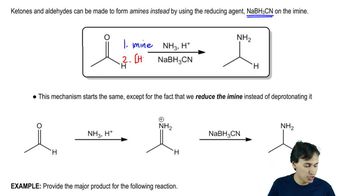
Step 2: Perform reductive amination on benzaldehyde. In this step, react benzaldehyde with ammonia (NH₃) to form an imine intermediate. This reaction typically requires acidic conditions to facilitate the formation of the imine.
Step 3: Reduce the imine intermediate to benzylamine. Use a reducing agent such as sodium cyanoborohydride (NaBH₃CN) or hydrogen gas (H₂) with a metal catalyst (e.g., Pd/C) to convert the imine to the amine group (-NH₂).
Step 4: Purify the benzylamine product. After the reaction is complete, isolate and purify the benzylamine using techniques such as distillation or recrystallization, depending on the physical properties of the product.
Step 5: Verify the structure of benzylamine. Use spectroscopic methods such as NMR (nuclear magnetic resonance) or IR (infrared spectroscopy) to confirm the successful synthesis of benzylamine from benzoic acid.

Verified video answer for a similar problem:

This video solution was recommended by our tutors as helpful for the problem above.
Video duration:
4m
Was this helpful?

Key Concepts

Here are the essential concepts you must grasp in order to answer the question correctly.

Reductive Amination

Reductive amination is a chemical reaction that involves the conversion of a carbonyl compound, such as an aldehyde or ketone, into an amine. This process typically involves the formation of an imine or enamine intermediate, which is then reduced to yield the corresponding amine. In the context of the question, this technique can be applied to convert benzoic acid into benzylamine by first forming an intermediate and then reducing it.
Recommended video:
Guided course
07:12
Reductive Amination

Reduction of Amides

The reduction of amides is a method used to convert amides into amines. This reaction typically involves the use of reducing agents such as lithium aluminum hydride (LiAlH4) or borane (BH3). In the case of the synthesis from benzoic acid to benzylamine, the carboxylic acid can be converted to an amide first, which can then be reduced to yield the desired amine product.
Recommended video:
Guided course
01:33
Amide Nomenclature

Functional Group Transformation

Functional group transformation refers to the process of converting one functional group into another through chemical reactions. In organic synthesis, this is crucial for modifying molecules to achieve desired properties or structures. The transformation of benzoic acid (a carboxylic acid) to benzylamine (an amine) involves multiple steps, including the conversion to an amide and subsequent reduction, showcasing the importance of understanding functional groups in organic chemistry.
Recommended video:
Guided course
02:36
Identifying Functional Groups