Ch. 19 - Amines
Wade - Organic Chemistry 9th Edition
Wade9th EditionOrganic ChemistryISBN: 9780135213728Not the one you use?Change textbook
Chapter 19, Problem 36d,e,f

Which of the following compounds are capable of being resolved into enantiomers?
(d) 1,2,2-trimethylaziridine
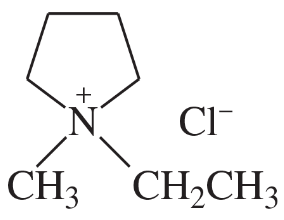
(e)
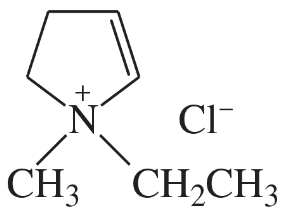
(f)

Verified step by step guidance
1
Step 1: To determine whether a compound can be resolved into enantiomers, check if the compound is chiral. Chirality arises when a molecule has a non-superimposable mirror image, typically due to the presence of an asymmetric carbon or a stereogenic center.
Step 2: Analyze the structure of 1,2,2-trimethylaziridine. Aziridine is a three-membered ring containing a nitrogen atom. In this case, the nitrogen is bonded to three different groups: a methyl group, another methyl group, and a hydrogen atom. The nitrogen atom can act as a stereogenic center if it is part of a chiral environment.
Step 3: Consider the nitrogen atom in the first image (quaternary ammonium salt). The nitrogen is bonded to four different groups: a methyl group, an ethyl group, a cyclopentyl group, and a chloride ion. This creates a chiral center, making the compound capable of being resolved into enantiomers.
Step 4: Examine the second image (quaternary ammonium salt with a double bond in the cyclopentyl ring). The nitrogen is still bonded to four different groups, and the double bond does not affect the chirality of the nitrogen. Therefore, this compound is also capable of being resolved into enantiomers.
Step 5: Summarize the findings: Both compounds in the images are quaternary ammonium salts with a chiral nitrogen center. Since the nitrogen is bonded to four different groups in both cases, these compounds are capable of being resolved into enantiomers.

Verified video answer for a similar problem:

This video solution was recommended by our tutors as helpful for the problem above.
Video duration:
4m
Was this helpful?

Key Concepts

Here are the essential concepts you must grasp in order to answer the question correctly.

Chirality

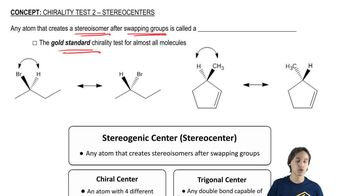
Chirality is a property of a molecule that makes it non-superimposable on its mirror image, much like left and right hands. A chiral molecule typically has at least one carbon atom bonded to four different substituents, creating two distinct forms known as enantiomers. Understanding chirality is essential for determining whether a compound can be resolved into enantiomers.
Recommended video:
Guided course
05:10
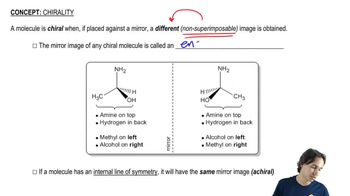
What is chirality?

Enantiomers

Enantiomers are a pair of chiral molecules that are mirror images of each other. They have identical physical properties in an achiral environment but can exhibit different behaviors in chiral environments, such as biological systems. Identifying whether a compound can form enantiomers is crucial for understanding its chemical behavior and potential applications.
Recommended video:
Guided course
03:23
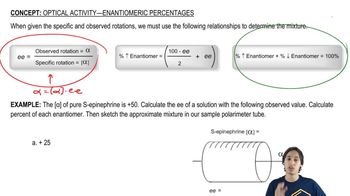
How to solve for the percentage of each enantiomer.

Stereocenters

A stereocenter, often a chiral center, is a specific atom in a molecule, usually carbon, that has four different substituents attached to it. The presence of one or more stereocenters in a compound is a key indicator of its potential to exist as enantiomers. Analyzing the stereocenters in a compound helps in determining its chirality and whether it can be resolved into enantiomers.
Recommended video:
Guided course
02:15
What is a stereocenter?