Ch. 20 - Carboxylic Acids
Wade - Organic Chemistry 9th Edition
Wade9th EditionOrganic ChemistryISBN: 9780135213728Not the one you use?Change textbook
Chapter 20, Problem 32

Arrange each group of compounds in order of increasing acidity.
(a) phenol, ethanol, acetic acid
(b) p-toluenesulfonic acid, acetic acid, chloroacetic acid
(c) benzoic acid, o-nitrobenzoic acid, m-nitrobenzoic acid
(d) butyric acid, α-bromobutyric acid, β-bromobutyric acid
(e) Chemical structures of carboxylic acids with halogen substituents, labeled with COOH groups.

Verified step by step guidance
1
Step 1: Understand the concept of acidity. Acidity is influenced by the ability of a compound to donate a proton (H⁺). Factors such as electronegativity, inductive effects, resonance, and the stability of the conjugate base play a role in determining acidity.
Step 2: Analyze the substituents attached to the carboxylic acid group in each compound. Electronegative substituents like F, Cl, and Br exert an inductive effect, pulling electron density away from the carboxylic acid group, stabilizing the conjugate base, and increasing acidity.
Step 3: Compare the electronegativity of the halogens (F, Cl, Br). Fluorine is the most electronegative, followed by chlorine, and then bromine. Therefore, the inductive effect is strongest for fluorine, making the compound with the fluorine substituent the most acidic.
Step 4: Consider the proximity of the halogen to the carboxylic acid group. All three compounds have the halogen directly attached to the carbon adjacent to the carboxylic acid group, so the inductive effect is comparable in terms of distance.
Step 5: Arrange the compounds in order of increasing acidity based on the electronegativity of the halogen substituents: the bromine-substituted compound is the least acidic, followed by the chlorine-substituted compound, and the fluorine-substituted compound is the most acidic.

Verified video answer for a similar problem:

This video solution was recommended by our tutors as helpful for the problem above.
Video duration:
8m
Was this helpful?

Key Concepts

Here are the essential concepts you must grasp in order to answer the question correctly.

Acidity and pKa

Acidity in organic chemistry refers to the tendency of a compound to donate a proton (H+). The strength of an acid is often measured by its pKa value; lower pKa values indicate stronger acids. Understanding the relationship between structure and acidity is crucial, as factors like electronegativity and resonance can significantly influence a compound's ability to release a proton.
Recommended video:
Guided course
07:45
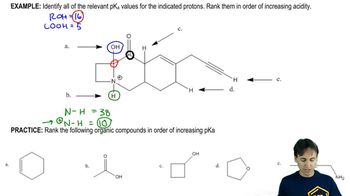
Identifying pKa values

Resonance Stabilization

Resonance stabilization occurs when a molecule can be represented by multiple valid Lewis structures, allowing for the delocalization of electrons. This delocalization can stabilize the conjugate base formed after deprotonation, thereby increasing the acidity of the original compound. For example, carboxylic acids benefit from resonance, making them generally more acidic than alcohols.
Recommended video:
Guided course
03:43
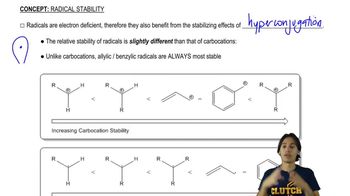
The radical stability trend.

Inductive Effect

The inductive effect refers to the electron-withdrawing or electron-donating effects of substituents on a molecule, which can influence acidity. Electronegative atoms or groups near the acidic proton can stabilize the negative charge of the conjugate base through inductive withdrawal, enhancing acidity. For instance, the presence of halogens in carboxylic acids can increase their acidity compared to their unsubstituted counterparts.
Recommended video:
Guided course
01:47
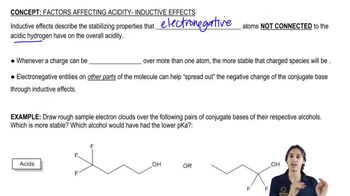
Understanding the Inductive Effect.