
Ch. 20 - Carboxylic Acids
Wade - Organic Chemistry 9th Edition
Wade9th EditionOrganic ChemistryISBN: 9780135213728Not the one you use?Change textbook
Chapter 20, Problem 15c

Show how Fischer esterification might be used to form the following esters. In each case, suggest a method for driving the reaction to completion.
(c) ethyl phenylacetate

Verified step by step guidance
1
Step 1: Understand the Fischer esterification process. Fischer esterification is a reaction between a carboxylic acid and an alcohol in the presence of an acid catalyst (commonly sulfuric acid) to form an ester and water. The reaction is reversible, so methods to drive the reaction to completion are important.
Step 2: Identify the reactants needed to form ethyl phenylacetate. Ethyl phenylacetate is an ester, so the carboxylic acid component is phenylacetic acid (C₆H₅CH₂COOH), and the alcohol component is ethanol (C₂H₅OH).
Step 3: Write the chemical equation for the reaction. The reaction can be represented as: C6H5CH2COOH+C2H5OHC6H5CH2COOC2H5+H2O. Sulfuric acid is used as a catalyst.
Step 4: Suggest a method to drive the reaction to completion. Since Fischer esterification is reversible, removing one of the products (water) can shift the equilibrium toward the formation of the ester. This can be achieved by using a Dean-Stark apparatus to continuously remove water during the reaction or by adding a drying agent to absorb water.
Step 5: Optimize reaction conditions. Use an excess of ethanol to further drive the equilibrium toward the ester product. Additionally, ensure the reaction is performed under reflux to maintain a consistent temperature and allow the reaction to proceed efficiently.

Verified video answer for a similar problem:

This video solution was recommended by our tutors as helpful for the problem above.
Video duration:
5m
Was this helpful?

Key Concepts

Here are the essential concepts you must grasp in order to answer the question correctly.

Fischer Esterification

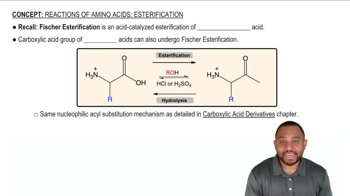
Fischer esterification is a chemical reaction that forms an ester from a carboxylic acid and an alcohol in the presence of an acid catalyst. The reaction is reversible, meaning that to drive it to completion, one must either remove the water produced or use an excess of one of the reactants. This method is commonly used in organic synthesis to create esters, which are important in various applications, including flavorings and fragrances.
Recommended video:
1:21
Reactions of Amino Acids: Esterification Concept 1

Driving the Reaction to Completion

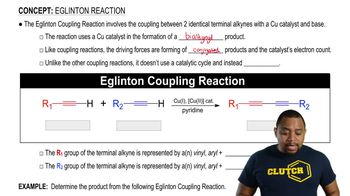
To drive the Fischer esterification reaction to completion, one effective method is to remove the water produced during the reaction. This can be achieved through techniques such as distillation or using a Dean-Stark apparatus. Alternatively, using an excess of either the carboxylic acid or the alcohol can shift the equilibrium towards the formation of the ester, thus increasing the yield of the desired product.
Recommended video:
Guided course
02:49
Eglinton Reaction

Structure of Ethyl Phenylacetate

Ethyl phenylacetate is an ester formed from phenylacetic acid and ethanol. Its structure consists of a phenyl group attached to a carbon chain that includes a carboxylate functional group, which is then esterified with an ethyl group. Understanding the molecular structure is crucial for predicting the reactivity and properties of the ester, as well as for designing the appropriate reaction conditions for its synthesis.
Recommended video:
Guided course
03:04
Drawing Resonance Structures
Related Practice
Textbook Question

The mechanism of the Fischer esterification was controversial until 1938, when Irving Roberts and Harold Urey of Columbia University used isotopic labeling to follow the alcohol oxygen atom through the reaction. A catalytic amount of sulfuric acid was added to a mixture of 1 mole of acetic acid and 1 mole of special methanol containing the heavy 18O isotope of oxygen. After a short period, the acid was neutralized to stop the reaction, and the components of the mixture were separated.

(a) Propose a mechanism for this reaction.

(b) Follow the labeled 18O atom through your mechanism, and show where it is found in the products.

951
views
Textbook Question

Show how Fischer esterification might be used to form the following esters. In each case, suggest a method for driving the reaction to completion.

(a) methyl salicylate

530
views
Textbook Question

(b) Finish the solution for Solved Problem 20-1 by providing a mechanism for the acid-catalyzed hydrolysis of ethyl formate.

929
views
Textbook Question

The given was missing some important resonance forms of the intermediates shown in brackets. Complete this mechanism by drawing all the resonance forms of these intermediates. Do your resonance forms help to explain why this reaction occurs under very mild conditions (water with a tiny trace of acid)?

1016
views
Textbook Question

What monosaccharides are formed in a modified Kiliani–Fischer synthesis starting with each of the following monosaccharides?

b. L-threose

645
views
Textbook Question

A carboxylic acid has two oxygen atoms, each with two nonbonding pairs of electrons.

(a) Draw the resonance forms of a carboxylic acid that is protonated on the hydroxy oxygen atom.

(b) Compare the resonance forms with those given previously for an acid protonated on the carbonyl oxygen atom.

(c) Explain why the carbonyl oxygen atom of a carboxylic acid is more basic than the hydroxy oxygen.

1933
views