Ch. 21 - Carboxylic Acid Derivatives
Wade - Organic Chemistry 9th Edition
Wade9th EditionOrganic ChemistryISBN: 9780135213728Not the one you use?Change textbook
Chapter 21, Problem 43i,j

Give appropriate names for the following compounds:
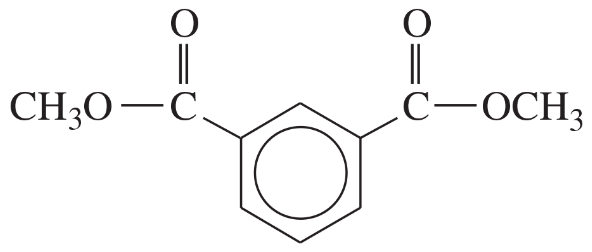
(i)
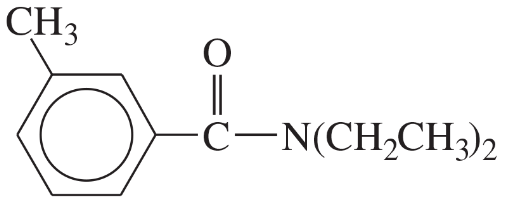
(j)

Verified step by step guidance
1
Step 1: Analyze the first compound (i). The structure contains a benzene ring with two substituents attached to it. Both substituents are ester groups (-COOCH₃) located at opposite positions (para position). This indicates a symmetrical substitution pattern.
Step 2: Assign the base name for the benzene ring. Since the substituents are esters, the parent name will be derived from 'benzene' with the prefix indicating the ester groups.
Step 3: Name the ester groups. Each ester group is a methoxycarbonyl group (-COOCH₃). Since they are located at the para position, the compound is named as 'para-dimethoxycarbonylbenzene' or '1,4-dimethoxycarbonylbenzene'.
Step 4: Analyze the second compound (j). The structure contains a benzene ring with two substituents: a methyl group (-CH₃) and an amide group (-CON(CH₂CH₃)₂). The methyl group is at the ortho position relative to the amide group.
Step 5: Assign the base name for the benzene ring in the second compound. The amide group (-CON(CH₂CH₃)₂) is the principal functional group, so the compound is named as 'N,N-diethyl-2-methylbenzamide'. The numbering starts from the amide group to give it the lowest possible number.

Verified video answer for a similar problem:

This video solution was recommended by our tutors as helpful for the problem above.
Video duration:
2m
Was this helpful?

Key Concepts

Here are the essential concepts you must grasp in order to answer the question correctly.

Nomenclature of Organic Compounds

Nomenclature in organic chemistry refers to the systematic naming of chemical compounds based on their structure and functional groups. The International Union of Pure and Applied Chemistry (IUPAC) provides rules for naming compounds, which include identifying the longest carbon chain, naming substituents, and indicating functional groups. Understanding these rules is essential for accurately naming complex molecules.
Recommended video:
Guided course
01:40
Defining meso compounds.

Functional Groups

Functional groups are specific groups of atoms within molecules that are responsible for the characteristic chemical reactions of those molecules. Common functional groups include amides, esters, and methoxy groups. Recognizing these groups helps in predicting the behavior of compounds and is crucial for proper nomenclature, as the presence of certain functional groups influences the naming conventions.
Recommended video:
Guided course
02:36
Identifying Functional Groups

Aromatic Compounds

Aromatic compounds are a class of cyclic compounds that contain conjugated pi electron systems, which follow Huckel's rule of 4n+2 pi electrons. These compounds, such as benzene and its derivatives, exhibit unique stability and reactivity due to resonance. Understanding the properties of aromatic compounds is vital for naming and predicting the behavior of compounds that contain benzene rings and substituents.
Recommended video:
Guided course
08:19
Intro to Aromaticity