Ch. 21 - Carboxylic Acid Derivatives
Wade - Organic Chemistry 9th Edition
Wade9th EditionOrganic ChemistryISBN: 9780135213728Not the one you use?Change textbook
Chapter 21, Problem 47b

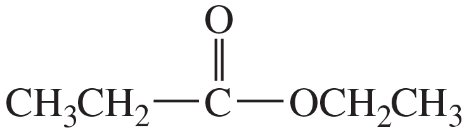
Predict the products of saponification of the following esters.
(b)

Verified step by step guidance
1
Step 1: Understand the concept of saponification. Saponification is a chemical reaction in which an ester reacts with a strong base (usually NaOH or KOH) to produce a carboxylate salt and an alcohol.
Step 2: Identify the ester in the given structure. The ester provided is ethyl propanoate, which consists of a propanoate group (CH3CH2CO-) and an ethoxy group (-OCH2CH3).
Step 3: Write the general reaction for saponification. The ester reacts with a strong base (e.g., NaOH) to form a carboxylate salt and an alcohol. The reaction can be represented as: R-COOR'+NaOHR-COONa+R'OH
Step 4: Apply the reaction to the given ester. In this case, the propanoate group (CH3CH2CO-) will form the carboxylate salt (CH3CH2COO-Na+), and the ethoxy group (-OCH2CH3) will form ethanol (CH3CH2OH).
Step 5: Summarize the products. The saponification of ethyl propanoate will yield sodium propanoate (CH3CH2COO-Na+) and ethanol (CH3CH2OH).

Verified video answer for a similar problem:

This video solution was recommended by our tutors as helpful for the problem above.
Video duration:
1m
Was this helpful?

Key Concepts

Here are the essential concepts you must grasp in order to answer the question correctly.

Saponification

Saponification is a chemical reaction that involves the hydrolysis of an ester in the presence of a strong base, typically sodium hydroxide (NaOH) or potassium hydroxide (KOH). This process results in the formation of an alcohol and a carboxylate salt, which is commonly known as soap. Understanding this reaction is crucial for predicting the products when esters undergo saponification.
Recommended video:

Esters

Esters are organic compounds formed from the reaction of an alcohol and a carboxylic acid, characterized by the functional group -COO-. They often have distinctive odors and are commonly found in fats, oils, and natural fragrances. Recognizing the structure of esters is essential for predicting the products of their reactions, including saponification.
Recommended video:
Guided course
02:39
Ester Nomenclature

Hydrolysis

Hydrolysis is a chemical process in which water is used to break down a compound. In the context of saponification, hydrolysis refers to the reaction of the ester with water, facilitated by a base, leading to the formation of an alcohol and a carboxylate ion. This concept is fundamental to understanding how esters are converted into their respective products during saponification.
Recommended video:
1:00
Hydrolysis of Thioesters Concept 2