

Ch. 21 - Carboxylic Acid Derivatives
Wade - Organic Chemistry 9th Edition
Wade9th EditionOrganic ChemistryISBN: 9780135213728Not the one you use?Change textbook
Chapter 21, Problem 54e,f

Show how you would accomplish the following syntheses. Some of these conversions may require more than one step.
(e) cyclohexylamine → N-cyclohexylacetamide
(f) bromocyclohexane → dicyclohexylmethanol

Verified step by step guidance
1
Step 1: For the conversion of cyclohexylamine to N-cyclohexylacetamide, start by recognizing that this is an acylation reaction. Cyclohexylamine (R-NH2) reacts with an acyl chloride (R'-COCl) to form an amide. Choose acetyl chloride (CH3COCl) as the acylating agent.
Step 2: Mix cyclohexylamine with acetyl chloride in the presence of a base like pyridine or triethylamine. The base neutralizes the HCl byproduct formed during the reaction, ensuring smooth conversion to N-cyclohexylacetamide.
Step 3: For the conversion of bromocyclohexane to dicyclohexylmethanol, recognize that this involves a Grignard reaction. First, convert bromocyclohexane to cyclohexylmagnesium bromide by reacting it with magnesium metal in dry ether.
Step 4: React cyclohexylmagnesium bromide with cyclohexanone (C6H10O). The Grignard reagent adds to the carbonyl group of cyclohexanone, forming an intermediate alkoxide.
Step 5: Perform an acidic workup (e.g., using dilute HCl or water) to protonate the alkoxide intermediate, yielding dicyclohexylmethanol as the final product.

Verified video answer for a similar problem:

This video solution was recommended by our tutors as helpful for the problem above.
Video duration:
6m
Was this helpful?

Key Concepts

Here are the essential concepts you must grasp in order to answer the question correctly.

Amine Reactivity

Cyclohexylamine is a primary amine that can undergo acylation to form N-cyclohexylacetamide. This reaction involves the nucleophilic attack of the amine on an acyl chloride or anhydride, leading to the formation of an amide bond. Understanding the reactivity of amines is crucial for predicting the products of such transformations.
Recommended video:
Guided course
07:12
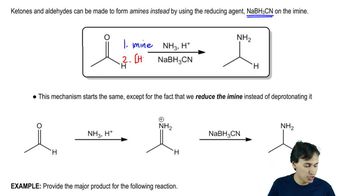
Reductive Amination

Bromination and Nucleophilic Substitution

Bromocyclohexane contains a bromine atom that can be replaced through nucleophilic substitution reactions. In the synthesis of dicyclohexylmethanol, the bromine can be displaced by a nucleophile, such as a cyclohexyl anion, followed by reduction to form the alcohol. Familiarity with substitution mechanisms is essential for planning multi-step syntheses.
Recommended video:
Guided course
01:47
Nucleophiles and Electrophiles can react in Substitution Reactions.

Reduction Reactions

Reduction reactions are key in organic synthesis, particularly when converting carbonyl compounds to alcohols. In the case of dicyclohexylmethanol, a carbonyl intermediate formed from the nucleophilic substitution can be reduced using reagents like lithium aluminum hydride or sodium borohydride. Understanding reduction mechanisms is vital for completing the synthesis effectively.
Recommended video:
Guided course
07:12
Reductive Amination