Ch. 21 - Carboxylic Acid Derivatives
Wade - Organic Chemistry 9th Edition
Wade9th EditionOrganic ChemistryISBN: 9780135213728Not the one you use?Change textbook
Chapter 21, Problem 36c,d

Show how you would accomplish the following synthetic transformations. You may use any necessary reagents.
(c) pyrrolidine → N-acetylpyrrolidine
(d) γ-aminobutyric acid → pyrrolidine

Verified step by step guidance
1
Step 1: For part (c), the transformation involves converting pyrrolidine into N-acetylpyrrolidine. This can be achieved by reacting pyrrolidine with acetic anhydride or acetyl chloride. These reagents introduce an acetyl group (-COCH3) to the nitrogen atom of pyrrolidine.
Step 2: The reaction mechanism for part (c) involves nucleophilic attack by the nitrogen atom of pyrrolidine on the carbonyl carbon of acetic anhydride or acetyl chloride. This forms a tetrahedral intermediate, which then collapses to release a leaving group (e.g., acetate or chloride) and forms the N-acetylpyrrolidine product.
Step 3: For part (d), the transformation involves converting γ-aminobutyric acid (GABA) into pyrrolidine. This requires cyclization of the molecule to form the pyrrolidine ring. The carboxylic acid group (-COOH) and the amino group (-NH2) are key functional groups involved in this process.
Step 4: To achieve cyclization in part (d), the carboxylic acid group can be activated using a dehydrating agent such as thionyl chloride (SOCl2) or carbodiimide reagents. This converts the carboxylic acid into a reactive intermediate (e.g., an acyl chloride or an ester), which can then react with the amino group to form the pyrrolidine ring.
Step 5: The reaction mechanism for part (d) involves intramolecular nucleophilic attack by the amino group on the activated carboxylic acid derivative, leading to ring closure and formation of pyrrolidine. This step may require heating to facilitate cyclization and drive the reaction to completion.

Verified video answer for a similar problem:

This video solution was recommended by our tutors as helpful for the problem above.
Video duration:
2m
Was this helpful?

Key Concepts

Here are the essential concepts you must grasp in order to answer the question correctly.

Amide Formation

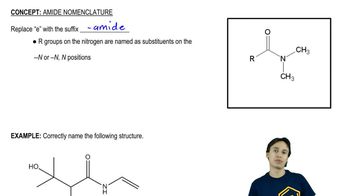
Amide formation is a key reaction in organic chemistry where a carboxylic acid reacts with an amine to form an amide. In the transformation from pyrrolidine to N-acetylpyrrolidine, an acetic anhydride or acetyl chloride can be used to introduce the acetyl group, resulting in the formation of the amide bond. Understanding this reaction is crucial for synthesizing derivatives of amines.
Recommended video:
Guided course
01:33
Amide Nomenclature

Decarboxylation

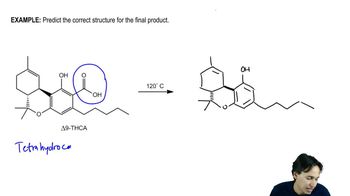
Decarboxylation is the process of removing a carboxyl group from a molecule, typically releasing carbon dioxide. In the transformation from γ-aminobutyric acid to pyrrolidine, decarboxylation occurs, which can be facilitated by heating or using a decarboxylation agent. This reaction is essential for converting amino acids into cyclic amines like pyrrolidine.
Recommended video:
Guided course
02:32
Predict the correct structure

Nucleophilic Substitution

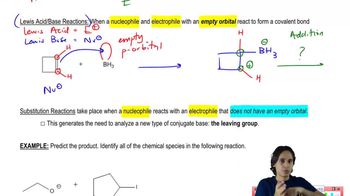
Nucleophilic substitution is a fundamental reaction mechanism in organic chemistry where a nucleophile attacks an electrophile, resulting in the replacement of a leaving group. In the context of the transformations, the nucleophilic amine group in pyrrolidine can attack an electrophilic carbon in acyl chlorides or anhydrides to form N-acetylpyrrolidine. This concept is vital for understanding how functional groups can be modified in organic synthesis.
Recommended video:
Guided course
01:47
Nucleophiles and Electrophiles can react in Substitution Reactions.