Ch. 21 - Carboxylic Acid Derivatives
Wade - Organic Chemistry 9th Edition
Wade9th EditionOrganic ChemistryISBN: 9780135213728Not the one you use?Change textbook
Chapter 21, Problem 35a,b,c

Show how you would synthesize each compound, starting with an ester containing no more than eight carbon atoms. Any other necessary reagents may be used.
(a) Ph3C–OH
(b) (PhCH2)2CHOH
(c) PhCONHCH2CH3

Verified step by step guidance
1
Step 1: For compound (a) Ph3C-OH, start with an ester containing no more than eight carbons, such as ethyl benzoate (C6H5COOCH2CH3). Perform a Grignard reaction by reacting ethyl benzoate with phenylmagnesium bromide (PhMgBr) to form the triphenylmethanol (Ph3C-OH). This involves the addition of the Grignard reagent to the ester, followed by hydrolysis.
Step 2: For compound (b) (PhCH2)2CHOH, begin with an ester like ethyl benzoate (C6H5COOCH2CH3). React ethyl benzoate with benzylmagnesium bromide (PhCH2MgBr) in excess to form the desired alcohol. The Grignard reagent adds twice to the ester, followed by hydrolysis to yield the secondary alcohol.
Step 3: For compound (c) PhCONHCH2CH3, start with ethyl benzoate (C6H5COOCH2CH3). Perform a reaction to convert the ester into a benzamide (PhCONH2) by reacting it with ammonia (NH3). Then, perform an alkylation reaction using ethyl iodide (CH3CH2I) to introduce the ethyl group on the nitrogen, forming PhCONHCH2CH3.
Step 4: Ensure that the reaction conditions for each step are carefully controlled. For Grignard reactions, use anhydrous conditions to prevent side reactions. For the amide formation, use a suitable base or catalyst to facilitate the reaction.
Step 5: Verify the structures of the synthesized compounds using spectroscopic techniques such as NMR and IR to confirm the presence of the functional groups and the overall molecular structure.

Verified video answer for a similar problem:

This video solution was recommended by our tutors as helpful for the problem above.
Video duration:
5m
Was this helpful?

Key Concepts

Here are the essential concepts you must grasp in order to answer the question correctly.

Ester Synthesis

Ester synthesis involves the reaction of an alcohol with a carboxylic acid or an acid derivative, typically through a condensation reaction that releases water. This process is fundamental in organic chemistry as it forms the backbone for creating various compounds, including the target compounds in the question. Understanding the reactivity of esters and their derivatives is crucial for planning synthetic routes.
Recommended video:
01:28
Synthesis of Amino Acids: Acetamidomalonic Ester Synthesis Example 2

Grignard Reagents

Grignard reagents are organomagnesium compounds that are highly reactive and can be used to form carbon-carbon bonds. They are generated by reacting magnesium with an alkyl or aryl halide. In the context of the question, Grignard reagents can be employed to synthesize alcohols from esters, making them essential for constructing the specified compounds.
Recommended video:
Guided course
02:12
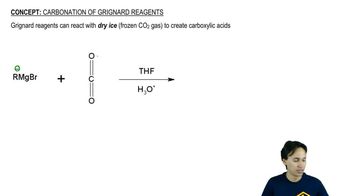
Carbonation of Grignard Reagents

Nucleophilic Addition

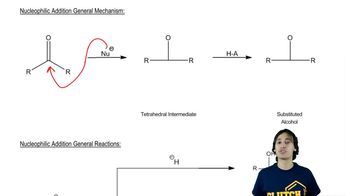
Nucleophilic addition is a fundamental reaction mechanism in organic chemistry where a nucleophile attacks an electrophilic carbon atom, leading to the formation of new bonds. This concept is particularly relevant for the synthesis of the target compounds, as it explains how various reagents can add to carbonyl groups in esters and ketones, facilitating the transformation into alcohols and amines.
Recommended video:
Guided course
08:27
Nucleophilic Addition