
Ch. 21 - Carboxylic Acid Derivatives
Wade - Organic Chemistry 9th Edition
Wade9th EditionOrganic ChemistryISBN: 9780135213728Not the one you use?Change textbook
Chapter 21, Problem 53a

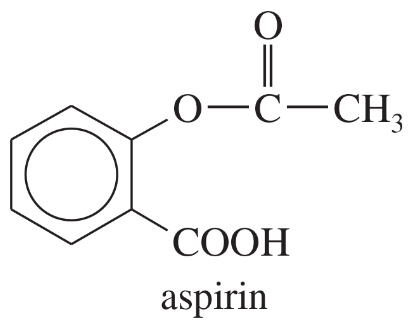
Two widely used pain relievers are aspirin and acetaminophen. Show how you would synthesize these drugs from phenol.

Verified step by step guidance
1
Step 1: Begin with phenol (C₆H₅OH) as the starting material. Phenol has a hydroxyl (-OH) group attached to a benzene ring, which can be functionalized to create both aspirin and acetaminophen.
Step 2: To synthesize acetaminophen, first convert phenol into para-aminophenol. This can be achieved by nitration of phenol to form para-nitrophenol, followed by reduction of the nitro group (-NO₂) to an amine group (-NH₂).
Step 3: Acetylate the para-aminophenol by reacting it with acetic anhydride (CH₃CO)₂O. This introduces the acetyl group (-COCH₃) to the amine group, forming acetaminophen (C₆H₄OHNHCOCH₃).
Step 4: To synthesize aspirin, first convert phenol into salicylic acid. This can be done by Kolbe-Schmitt reaction, where phenol reacts with carbon dioxide (CO₂) under basic conditions to form salicylic acid (C₆H₄OHCOOH).
Step 5: Acetylate salicylic acid by reacting it with acetic anhydride (CH₃CO)₂O. This introduces the acetyl group (-COCH₃) to the hydroxyl group, forming aspirin (C₆H₄COOHCOCH₃).

Verified video answer for a similar problem:

This video solution was recommended by our tutors as helpful for the problem above.
Video duration:
3m
Was this helpful?

Key Concepts

Here are the essential concepts you must grasp in order to answer the question correctly.

Phenol

Phenol is an aromatic compound characterized by a hydroxyl group (-OH) attached to a benzene ring. It serves as a key starting material in organic synthesis, particularly for the production of various pharmaceuticals, including aspirin and acetaminophen. Understanding its reactivity and functional group transformations is essential for synthesizing these drugs.
Recommended video:
Guided course
02:27
Identify the most acidic phenol

Acetaminophen Synthesis

Acetaminophen, or paracetamol, can be synthesized from phenol through a two-step process: first, phenol is converted to an aniline derivative via nitration and reduction, followed by acetylation of the amine group. This process highlights the importance of functional group transformations in organic synthesis, particularly in drug development.
Recommended video:
1:16
Synthesis of Amino Acids: Strecker Synthesis Example 1

Aspirin Synthesis

Aspirin, or acetylsalicylic acid, can be synthesized from phenol by first converting it to salicylic acid through a hydroxylation reaction, followed by acetylation of the hydroxyl group. This synthesis pathway illustrates the significance of esterification reactions in organic chemistry, particularly in the context of creating analgesic compounds.
Recommended video:
1:16
Synthesis of Amino Acids: Strecker Synthesis Example 1
Related Practice
Textbook Question

Phosgene is the acid chloride of carbonic acid. Although phosgene was used as a war gas in World War I, it is now used as a reagent for the synthesis of many useful products. Phosgene reacts like other acid chlorides, but it can react twice.

(b) Predict the products formed when phosgene reacts with 1 equivalent of methanol, followed by 1 equivalent of aniline.

505
views
Textbook Question

Show how you would accomplish the following syntheses. Some of these conversions may require more than one step.

(c) isobutylamine → N-isobutylformamide

532
views
Textbook Question

Show how you would accomplish the following syntheses. Some of these conversions may require more than one step.

(a) isopentyl alcohol → isopentyl acetate (banana oil)

671
views
Textbook Question

Show how you would accomplish the following syntheses. Some of these conversions may require more than one step.

(b) 3-ethylpentanoic acid → 3-ethylpentanenitrile

540
views
Textbook Question

Phosgene is the acid chloride of carbonic acid. Although phosgene was used as a war gas in World War I, it is now used as a reagent for the synthesis of many useful products. Phosgene reacts like other acid chlorides, but it can react twice.

(a) Predict the products formed when phosgene reacts with excess propan-2-ol.

710
views
Textbook Question

An ether extraction of nutmeg gives large quantities of trimyristin, a waxy crystalline solid of melting point 57°C. The IR spectrum of trimyristin shows a very strong absorption at 1733 cm-1. Basic hydrolysis of trimyristin gives 1 equivalent of glycerol and 3 equivalents of myristic acid (tetradecanoic acid).

(a) Draw the structure of trimyristin.

(b) Predict the products formed when trimyristin is treated with lithium aluminum hydride, followed by aqueous hydrolysis of the aluminum salts.

2196
views