Ch. 22 - Condensations and Alpha Substitutions of Carbonyl Compounds
Wade - Organic Chemistry 9th Edition
Wade9th EditionOrganic ChemistryISBN: 9780135213728Not the one you use?Change textbook
Chapter 22, Problem 13

Predict the products of the following reactions.
(a) cyclopentyl methyl ketone + excess Cl2 + excess NaOH
(b) 1-cyclopentylethanol + excess I2 + excess NaOH
(c) propiophenone + excess Br2 + excess NaOH

Verified step by step guidance
1
Step 1: Recognize the type of reaction. All three reactions involve halogenation in the presence of a strong base (NaOH). This is a classic example of the haloform reaction, which occurs with methyl ketones or alcohols that can be oxidized to methyl ketones.
Step 2: For reaction (a), cyclopentyl methyl ketone reacts with excess Cl2 and NaOH. The methyl group adjacent to the carbonyl group undergoes multiple halogenations, replacing all three hydrogens with chlorine atoms to form a trichloromethyl group. This group is then cleaved by the base to form chloroform (CHCl3) and a carboxylate ion derived from the remaining part of the molecule.
Step 3: For reaction (b), 1-cyclopentylethanol is a secondary alcohol. In the presence of excess I2 and NaOH, the alcohol is first oxidized to a ketone (cyclopentyl methyl ketone). The ketone then undergoes the haloform reaction as described in step 2, producing iodoform (CHI3) and a carboxylate ion.
Step 4: For reaction (c), propiophenone (C6H5-CH2-CO-CH3) contains a methyl ketone group. In the presence of excess Br2 and NaOH, the methyl group adjacent to the carbonyl undergoes halogenation to form a tribromomethyl group. This group is cleaved by the base to produce bromoform (CHBr3) and a carboxylate ion derived from the remaining part of the molecule.
Step 5: Summarize the products for each reaction: (a) chloroform (CHCl3) and the carboxylate ion of cyclopentane carboxylic acid, (b) iodoform (CHI3) and the carboxylate ion of cyclopentane carboxylic acid, (c) bromoform (CHBr3) and the carboxylate ion of benzoic acid.

Verified video answer for a similar problem:

This video solution was recommended by our tutors as helpful for the problem above.
Video duration:
10m
Was this helpful?

Key Concepts

Here are the essential concepts you must grasp in order to answer the question correctly.

Halogenation of Ketones

Halogenation of ketones involves the reaction of ketones with halogens in the presence of a base, leading to the formation of α-halo ketones. The base facilitates the deprotonation of the ketone, allowing the halogen to add to the α-carbon. Understanding this mechanism is crucial for predicting the products of reactions involving cyclopentyl methyl ketone and propiophenone.
Recommended video:
Guided course
02:27
Name the ketone

Oxidation of Alcohols

The oxidation of alcohols, particularly secondary alcohols like 1-cyclopentylethanol, can be achieved using iodine in the presence of a base. This reaction typically leads to the formation of ketones or aldehydes, depending on the structure of the alcohol. Recognizing the oxidation state changes and the role of the reagents is essential for predicting the products in this reaction.
Recommended video:
Guided course
05:53
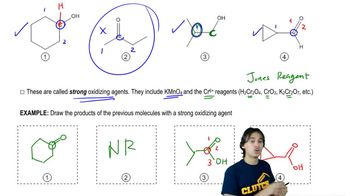
Strong oxidizing agents

Reactivity of α-Halo Compounds

α-Halo compounds, formed from the halogenation of ketones, can undergo further reactions such as nucleophilic substitution or elimination. In the presence of a strong base like NaOH, these compounds can react to form enolates or undergo dehydrohalogenation. Understanding the reactivity of these intermediates is key to predicting the final products of the reactions presented.
Recommended video:
Guided course
01:40
Defining meso compounds.