Ch. 22 - Condensations and Alpha Substitutions of Carbonyl Compounds
Wade - Organic Chemistry 9th Edition
Wade9th EditionOrganic ChemistryISBN: 9780135213728Not the one you use?Change textbook
Chapter 22, Problem 41

Propose a mechanism for the crossed Claisen condensation between ethyl acetate and ethyl benzoate.

Verified step by step guidance
1
Step 1: Identify the reactants and the type of reaction. The crossed Claisen condensation involves two esters, ethyl acetate (CH₃COOCH₂CH₃) and ethyl benzoate (C₆H₅COOCH₂CH₃), reacting in the presence of a strong base to form a β-keto ester.
Step 2: Deprotonation of the α-hydrogen. A strong base, such as sodium ethoxide (NaOCH₂CH₃), deprotonates the α-hydrogen of ethyl acetate, forming an enolate ion. The enolate ion is stabilized by resonance, with the negative charge delocalized between the oxygen atom and the α-carbon.
Step 3: Nucleophilic attack of the enolate ion. The enolate ion acts as a nucleophile and attacks the carbonyl carbon of ethyl benzoate. This step forms a tetrahedral intermediate, where the negative charge is temporarily localized on the oxygen atom of the carbonyl group.
Step 4: Collapse of the tetrahedral intermediate. The tetrahedral intermediate collapses, expelling the ethoxide ion (CH₃CH₂O⁻) as a leaving group. This step results in the formation of a β-keto ester, where the two original esters are now connected through a new carbon-carbon bond.
Step 5: Protonation of the product. The β-keto ester formed in the previous step is protonated by the solvent or another proton source, stabilizing the final product. The reaction is complete, yielding the crossed Claisen condensation product.

Verified video answer for a similar problem:

This video solution was recommended by our tutors as helpful for the problem above.
Was this helpful?

Key Concepts

Here are the essential concepts you must grasp in order to answer the question correctly.

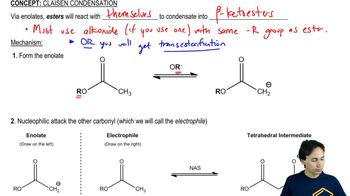
Claisen Condensation

Claisen condensation is a reaction between two esters or an ester and a carbonyl compound in the presence of a strong base, leading to the formation of a β-keto ester or a β-diketone. This reaction involves the nucleophilic attack of an enolate ion, generated from one of the esters, on the carbonyl carbon of the other ester. Understanding this mechanism is crucial for proposing the crossed Claisen condensation between ethyl acetate and ethyl benzoate.
Recommended video:
Guided course
08:28
Claisen Condensation

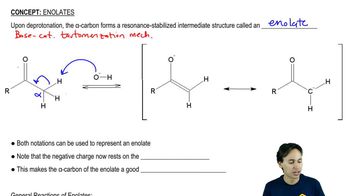
Enolate Ion Formation

Enolate ions are formed when a strong base abstracts a proton from the α-carbon of an ester or carbonyl compound, resulting in a resonance-stabilized anion. This enolate ion acts as a nucleophile in the Claisen condensation, attacking the electrophilic carbonyl carbon of another ester. Recognizing how enolate ions are generated and their role in nucleophilic attacks is essential for understanding the mechanism of the crossed Claisen condensation.
Recommended video:
Guided course
02:26
Formation of Enolates

Crossed Claisen Condensation

Crossed Claisen condensation refers to the reaction between two different esters or an ester and a carbonyl compound, which can lead to the formation of a new carbon-carbon bond. This reaction is selective and can yield different products depending on the choice of reactants and the conditions used. Analyzing the specific reactants, such as ethyl acetate and ethyl benzoate, is vital for predicting the outcome and mechanism of the reaction.
Recommended video:
Guided course
08:28
Claisen Condensation