Ch. 22 - Condensations and Alpha Substitutions of Carbonyl Compounds
Wade - Organic Chemistry 9th Edition
Wade9th EditionOrganic ChemistryISBN: 9780135213728Not the one you use?Change textbook
Chapter 22, Problem 77a

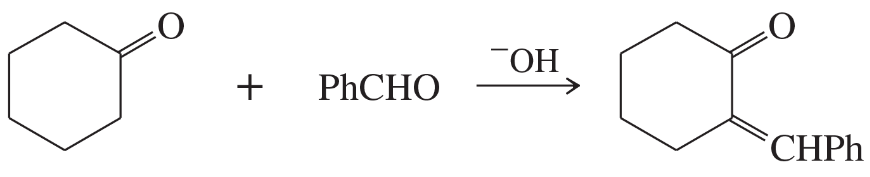
Propose mechanisms for the following reactions.
(a)

Verified step by step guidance
1
Analyze the given reaction: Identify the reactants, products, and reaction conditions (e.g., acid/base, heat, catalyst). This will help determine the type of reaction mechanism (e.g., substitution, elimination, addition, etc.).
Determine the reactive sites: Look for functional groups or atoms in the reactants that are likely to participate in the reaction. For example, electrophilic or nucleophilic centers, double bonds, or leaving groups.
Propose the first step of the mechanism: Identify the initial interaction between reactants. For example, a nucleophile attacking an electrophile, protonation/deprotonation, or bond cleavage. Use curved arrows to show the movement of electrons.
Outline subsequent steps: Based on the first step, predict the intermediate(s) formed and how they will proceed to form the product. Consider rearrangements, further attacks, or elimination steps if necessary. Use curved arrows to show electron flow in each step.
Verify the mechanism: Ensure that the proposed mechanism accounts for all reactants and products, follows the rules of electron flow, and is consistent with the reaction conditions provided.

Verified video answer for a similar problem:

This video solution was recommended by our tutors as helpful for the problem above.
Was this helpful?

Key Concepts

Here are the essential concepts you must grasp in order to answer the question correctly.

Reaction Mechanisms

A reaction mechanism is a step-by-step description of how a chemical reaction occurs at the molecular level. It outlines the sequence of elementary steps, including bond breaking and forming, and the intermediates involved. Understanding mechanisms is crucial for predicting the products of reactions and the conditions under which they occur.
Recommended video:
Guided course
02:16
Heck Reaction Mechanism

Types of Organic Reactions

Organic reactions can be classified into several types, including substitution, addition, elimination, and rearrangement reactions. Each type has distinct characteristics and mechanisms. Recognizing the type of reaction helps in predicting the behavior of reactants and the nature of the products formed.
Recommended video:
Guided course
07:37
Properties and Types of Pericyclic Reactions

Curved Arrow Notation

Curved arrow notation is a visual representation used in organic chemistry to illustrate the movement of electrons during a reaction. Arrows indicate the direction of electron flow, helping to clarify how bonds are broken and formed. Mastery of this notation is essential for accurately depicting reaction mechanisms.
Recommended video:
Guided course
06:20
Alternative MO Notation for Dienes