Ch. 22 - Condensations and Alpha Substitutions of Carbonyl Compounds
Wade - Organic Chemistry 9th Edition
Wade9th EditionOrganic ChemistryISBN: 9780135213728Not the one you use?Change textbook
Chapter 22, Problem 56d

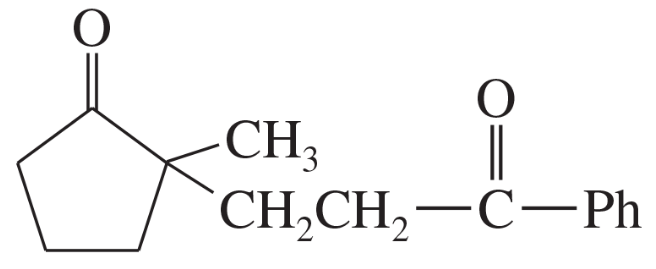
Show how the following products might be synthesized from suitable Michael donors and acceptors.
(d)

Verified step by step guidance
1
Step 1: Identify the Michael reaction components. The Michael reaction involves a nucleophilic addition of a Michael donor (a compound with an active methylene group, such as a β-diketone or β-ketoester) to a Michael acceptor (an α,β-unsaturated carbonyl compound). For product (d), the Michael donor could be a β-ketoester or β-diketone, and the acceptor could be an α,β-unsaturated ketone or ester.
Step 2: Analyze the structure of product (d). The product contains a cyclopentanone ring with a methyl group and a phenyl-substituted ketone side chain. This suggests that the Michael donor must have contributed the cyclopentanone ring, while the Michael acceptor must have contributed the phenyl-substituted ketone group.
Step 3: Propose the Michael donor and acceptor for product (d). A suitable Michael donor could be 2-methylcyclopentanone, which has an active methylene group adjacent to the carbonyl. A suitable Michael acceptor could be phenyl vinyl ketone (Ph-CH=CH-CO). The reaction would involve the nucleophilic attack of the active methylene group on the β-carbon of the Michael acceptor.
Step 4: Analyze the structure of product (e). The product contains two ketone groups and a branched chain with a methyl group. This suggests that the Michael donor must have contributed the branched chain, while the Michael acceptor must have contributed the terminal ketone group.
Step 5: Propose the Michael donor and acceptor for product (e). A suitable Michael donor could be isobutyrylacetone (CH3-CO-CH2-CH(CH3)-CO-CH3), which has an active methylene group. A suitable Michael acceptor could be methyl vinyl ketone (CH2=CH-CO-CH3). The reaction would involve the nucleophilic attack of the active methylene group on the β-carbon of the Michael acceptor, followed by protonation to yield the final product.

Verified video answer for a similar problem:

This video solution was recommended by our tutors as helpful for the problem above.
Video duration:
2m
Was this helpful?

Key Concepts

Here are the essential concepts you must grasp in order to answer the question correctly.

Michael Addition

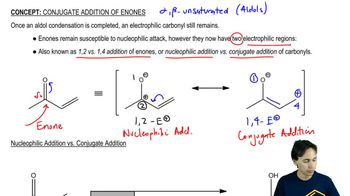
Michael addition is a nucleophilic addition reaction where a nucleophile adds to an α,β-unsaturated carbonyl compound. In this reaction, a Michael donor, typically a compound with a nucleophilic site, attacks the electrophilic β-carbon of the unsaturated carbonyl, forming a new carbon-carbon bond. This reaction is fundamental in organic synthesis for constructing complex molecules.
Recommended video:
Guided course
09:23
1,2 vs 1,4 Addition

Michael Donors and Acceptors

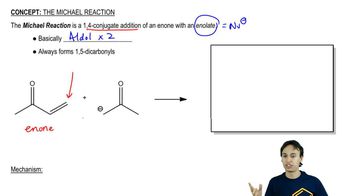
Michael donors are nucleophilic species that can donate electrons, such as enolates or other compounds with electron-rich sites. Michael acceptors, on the other hand, are typically α,β-unsaturated carbonyl compounds that can accept electrons due to the presence of a partial positive charge on the β-carbon. Understanding the nature of these donors and acceptors is crucial for predicting the outcome of Michael addition reactions.
Recommended video:
Guided course
02:34
General Reaction

Synthesis Strategies

Synthesis strategies in organic chemistry involve planning the steps required to construct a desired molecule from simpler starting materials. This includes selecting appropriate Michael donors and acceptors, determining reaction conditions, and considering the stereochemistry of the products. Effective synthesis requires a deep understanding of reaction mechanisms and the reactivity of various functional groups.
Recommended video:
1:16
Synthesis of Amino Acids: Strecker Synthesis Example 1