Ch. 22 - Condensations and Alpha Substitutions of Carbonyl Compounds
Wade - Organic Chemistry 9th Edition
Wade9th EditionOrganic ChemistryISBN: 9780135213728Not the one you use?Change textbook
Chapter 22, Problem 82b

Show the structure of the compound that results from hydrolysis and decarboxylation of the product.
Chemical reaction diagram showing benzaldehyde and malonic ester reacting to form a compound undergoing hydrolysis and decarboxylation.

Verified step by step guidance
1
Step 1: Analyze the reaction sequence. The first step involves the reaction of benzaldehyde with malonic ester in the presence of a base (NaOCH2CH3). This is a typical example of the Knoevenagel condensation, where the malonic ester acts as a nucleophile and forms a double bond with the benzaldehyde.
Step 2: Examine the product of the Knoevenagel condensation. The product is a compound with a benzene ring attached to a CH=C group, which is further connected to two ester groups (-COOCH2CH3). This intermediate is ready for hydrolysis and decarboxylation.
Step 3: Understand the hydrolysis step. Under acidic conditions (H3O+), the ester groups (-COOCH2CH3) are hydrolyzed to carboxylic acids (-COOH). This converts the intermediate into a compound with two carboxylic acid groups attached to the CH=C group.
Step 4: Decarboxylation occurs upon heating (Δ). One of the carboxylic acid groups is removed as CO2, leaving behind a single carboxylic acid group. This step simplifies the structure and results in the final product.
Step 5: The final structure is a compound with a benzene ring attached to a CH=CH group, which is further connected to a single carboxylic acid group (-COOH). This is the result of hydrolysis and decarboxylation of the intermediate.

Verified video answer for a similar problem:

This video solution was recommended by our tutors as helpful for the problem above.
Video duration:
3m
Was this helpful?

Key Concepts

Here are the essential concepts you must grasp in order to answer the question correctly.

Hydrolysis

Hydrolysis is a chemical reaction involving the breaking of a bond in a molecule using water. In organic chemistry, it often refers to the conversion of esters, amides, or other functional groups into their corresponding acids or alcohols. This process is crucial for understanding how complex molecules can be transformed into simpler ones, which is essential for analyzing reaction mechanisms.
Recommended video:
1:00
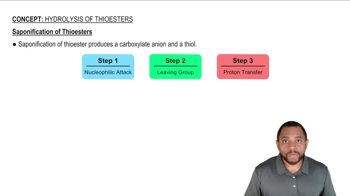
Hydrolysis of Thioesters Concept 2

Decarboxylation

Decarboxylation is the process of removing a carboxyl group (-COOH) from a molecule, typically releasing carbon dioxide (CO2). This reaction is significant in organic chemistry as it often leads to the formation of alkanes or other hydrocarbons from carboxylic acids. Understanding decarboxylation is vital for predicting the products of reactions involving carboxylic acids and their derivatives.
Recommended video:
Guided course
02:32
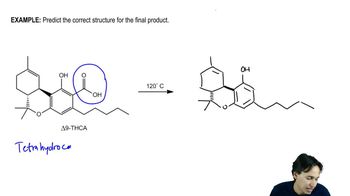
Predict the correct structure

Reaction Mechanisms

Reaction mechanisms describe the step-by-step sequence of elementary reactions by which overall chemical change occurs. In organic chemistry, understanding the mechanism helps predict the products of reactions, including hydrolysis and decarboxylation. A clear grasp of mechanisms allows chemists to manipulate conditions to favor desired outcomes in synthetic pathways.
Recommended video:
Guided course
02:16
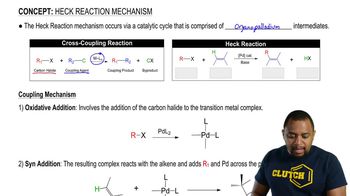
Heck Reaction Mechanism