Ch. 22 - Condensations and Alpha Substitutions of Carbonyl Compounds
Wade - Organic Chemistry 9th Edition
Wade9th EditionOrganic ChemistryISBN: 9780135213728Not the one you use?Change textbook
Chapter 22, Problem 33a

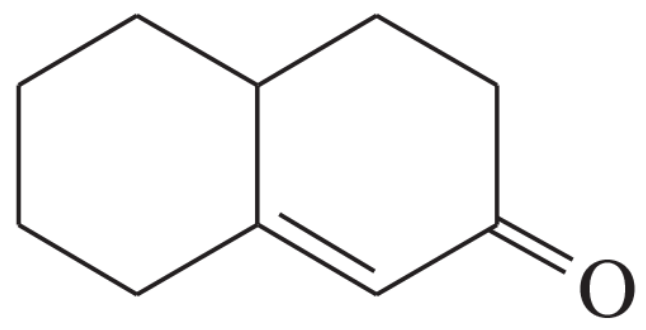
The following compound results from base-catalyzed aldol cyclization of a 2-substituted cyclohexanone.

(a) Show the diketone that would cyclize to give this product.

Verified step by step guidance
1
Step 1: Analyze the given product structure. The compound is a bicyclic ketone with a cyclohexane ring fused to a cyclopentane ring. The ketone group is located on the cyclopentane ring.
Step 2: Recall the mechanism of base-catalyzed aldol cyclization. This reaction involves the formation of a new carbon-carbon bond between two carbonyl groups, typically resulting in a cyclic structure.
Step 3: Identify the diketone precursor. To form the bicyclic structure, the diketone must have two carbonyl groups positioned such that they can undergo intramolecular aldol condensation. In this case, the precursor would be a 2-substituted cyclohexanone with a second ketone group at the appropriate position.
Step 4: Draw the diketone structure. The diketone should have one ketone group on the cyclohexane ring and another ketone group on the side chain at the position that allows cyclization to form the five-membered ring.
Step 5: Verify the connectivity. Ensure that the diketone structure aligns with the product after cyclization, considering the formation of the new bond and the elimination of water during the aldol condensation.

Verified video answer for a similar problem:

This video solution was recommended by our tutors as helpful for the problem above.
Video duration:
2m
Was this helpful?

Key Concepts

Here are the essential concepts you must grasp in order to answer the question correctly.

Aldol Condensation

Aldol condensation is a fundamental reaction in organic chemistry where an enolate ion reacts with a carbonyl compound to form a β-hydroxy aldehyde or ketone. This reaction can occur intramolecularly, leading to the formation of cyclic compounds. The process typically involves a base that deprotonates the carbon adjacent to the carbonyl, generating the enolate, which then attacks the carbonyl carbon of another molecule.
Recommended video:
Guided course
09:51
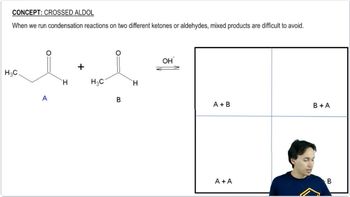
Crossed Aldol

Cyclization

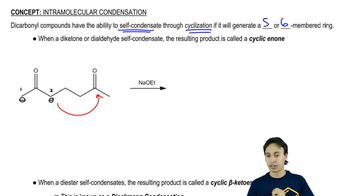
Cyclization refers to the process of forming a cyclic compound from a linear precursor. In the context of aldol reactions, intramolecular cyclization occurs when a diketone or a similar compound undergoes a reaction where the nucleophile and electrophile are part of the same molecule, leading to the formation of a ring structure. This is significant in synthesizing complex cyclic molecules, often seen in natural products and pharmaceuticals.
Recommended video:
Guided course
12:58
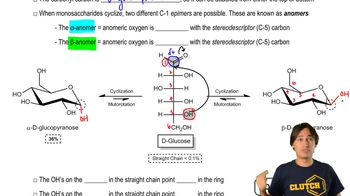
Monosaccharides - Cyclization

Diketones

Diketones are organic compounds containing two carbonyl groups (C=O) within the same molecule. They can serve as precursors in aldol reactions, where one carbonyl group can form an enolate and react with the other carbonyl group to create a cyclic structure. Understanding the structure and reactivity of diketones is crucial for predicting the products of aldol cyclization and for designing synthetic pathways in organic chemistry.
Recommended video: