

Ch. 22 - Condensations and Alpha Substitutions of Carbonyl Compounds
Wade - Organic Chemistry 9th Edition
Wade9th EditionOrganic ChemistryISBN: 9780135213728Not the one you use?Change textbook
Chapter 22, Problem 74a

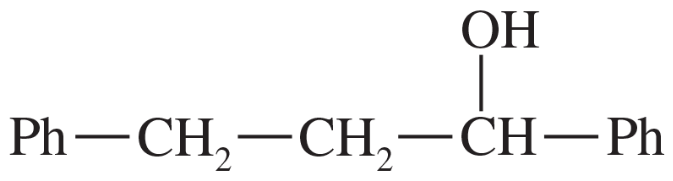
The following compounds can be synthesized by aldol condensations, followed by further reactions. (In each case, work backward from the target molecule to an aldol product, and show what compounds are needed for the condensation.)
(a)

Verified step by step guidance
1
Step 1: Analyze the target molecule. The given compound contains a hydroxyl group (-OH) attached to a carbon chain, which is connected to a benzene ring. This suggests that the molecule could be synthesized via an aldol condensation followed by further reactions.
Step 2: Work backward to identify the aldol product. The hydroxyl group indicates that the molecule could have been formed from an aldol addition product, which is typically a β-hydroxy ketone or aldehyde. The benzene ring suggests that one of the starting materials might be benzaldehyde.
Step 3: Determine the two starting materials for the aldol condensation. The carbon chain connecting the benzene ring to the hydroxyl group suggests that the other starting material could be a ketone or aldehyde with a methyl group and a longer chain. For example, acetone or a similar compound could be used.
Step 4: Write the aldol condensation reaction. Combine benzaldehyde and the chosen ketone or aldehyde under basic conditions to form the β-hydroxy ketone intermediate. Use MathML to represent the reaction: C6H5CHO + CH3COCH2CH3β-hydroxy-ketone
Step 5: Propose further reactions to obtain the target molecule. The β-hydroxy ketone can undergo dehydration to form an α,β-unsaturated ketone, followed by reduction to yield the final alcohol product. This reduction can be achieved using reagents like NaBH4 or LiAlH4.

Verified video answer for a similar problem:

This video solution was recommended by our tutors as helpful for the problem above.
Video duration:
6m
Was this helpful?

Key Concepts

Here are the essential concepts you must grasp in order to answer the question correctly.

Aldol Condensation

Aldol condensation is a fundamental reaction in organic chemistry where two aldehydes or ketones react in the presence of a base to form a β-hydroxy aldehyde or ketone, which can further dehydrate to yield an α,β-unsaturated carbonyl compound. This reaction is crucial for forming carbon-carbon bonds and is often used in the synthesis of complex organic molecules.
Recommended video:
Guided course
09:51
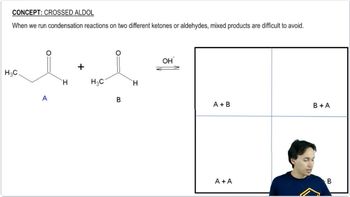
Crossed Aldol

Retrosynthetic Analysis

Retrosynthetic analysis is a strategy used in organic synthesis to deconstruct a target molecule into simpler precursor structures. By working backward from the desired product, chemists can identify the necessary starting materials and reactions needed to synthesize the compound, facilitating the planning of synthetic routes.
Recommended video:
Guided course
01:22
Retrosynthesis

Functional Groups

Functional groups are specific groups of atoms within molecules that are responsible for the characteristic chemical reactions of those molecules. Understanding functional groups, such as alcohols, aldehydes, and ketones, is essential for predicting the behavior of compounds in reactions like aldol condensation and for identifying potential starting materials in synthetic pathways.
Recommended video:
Guided course
02:36
Identifying Functional Groups