Ch. 22 - Condensations and Alpha Substitutions of Carbonyl Compounds
Wade - Organic Chemistry 9th Edition
Wade9th EditionOrganic ChemistryISBN: 9780135213728Not the one you use?Change textbook
Chapter 22, Problem 78c

Write equations showing the expected products of the following enamine alkylation and acylation reactions. Then give the final products expected after hydrolysis of the iminium salts.
(c) piperidine enamine of cyclopentanone + methyl iodide

Verified step by step guidance
1
Step 1: Recognize that the reaction involves the piperidine enamine of cyclopentanone. An enamine is formed by the reaction of a secondary amine (like piperidine) with a ketone (cyclopentanone). The enamine structure has a double bond adjacent to the nitrogen atom.
Step 2: Understand that the enamine acts as a nucleophile in the alkylation reaction. The double bond in the enamine will attack the electrophilic carbon in methyl iodide (CH₃I), displacing the iodide ion (I⁻) and forming a new carbon-carbon bond.
Step 3: Write the equation for the alkylation reaction. The enamine reacts with methyl iodide to form an intermediate iminium salt. The iminium salt has a positively charged nitrogen atom and a new methyl group attached to the former enamine carbon.
Step 4: Recognize that hydrolysis of the iminium salt regenerates the original ketone structure with the new alkyl group (methyl) added to the alpha-carbon of the ketone. This occurs because water attacks the iminium carbon, leading to the cleavage of the C=N bond and formation of a carbonyl group.
Step 5: Write the final product after hydrolysis. The product is 2-methylcyclopentanone, where the methyl group is attached to the alpha-carbon of the cyclopentanone ring.

Verified video answer for a similar problem:

This video solution was recommended by our tutors as helpful for the problem above.
Video duration:
6m
Was this helpful?

Key Concepts

Here are the essential concepts you must grasp in order to answer the question correctly.

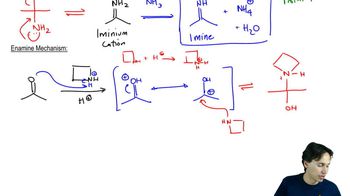
Enamines

Enamines are derivatives of carbonyl compounds formed by the reaction of an aldehyde or ketone with a secondary amine. They contain a C=C bond adjacent to a nitrogen atom, which makes them nucleophilic and reactive towards electrophiles. In the context of alkylation and acylation, enamines can act as nucleophiles, allowing for the introduction of alkyl or acyl groups to the carbon chain.
Recommended video:
Guided course
06:25
Enamine Mechanism

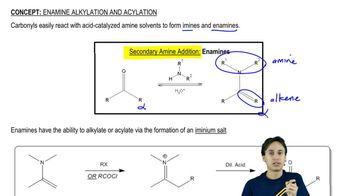
Iminium Salts

Iminium salts are formed when an enamine reacts with an electrophile, such as an alkyl halide, resulting in the addition of the electrophile to the nitrogen atom. This reaction generates a positively charged nitrogen species, which can be hydrolyzed to yield the corresponding carbonyl compound. Understanding the formation and hydrolysis of iminium salts is crucial for predicting the final products of reactions involving enamines.
Recommended video:
Guided course
03:36
General Reaction

Hydrolysis

Hydrolysis is a chemical reaction involving the breakdown of a compound by water, often resulting in the formation of new products. In the case of iminium salts, hydrolysis leads to the regeneration of the original carbonyl compound and the amine. This step is essential for completing the reaction sequence and understanding the final products formed after the alkylation or acylation of enamines.
Recommended video:
1:00
Hydrolysis of Thioesters Concept 2