Ch. 23 - Carbohydrates and Nucleic Acids
Wade - Organic Chemistry 9th Edition
Wade9th EditionOrganic ChemistryISBN: 9780135213728Not the one you use?Change textbook
Chapter 23, Problem 44a

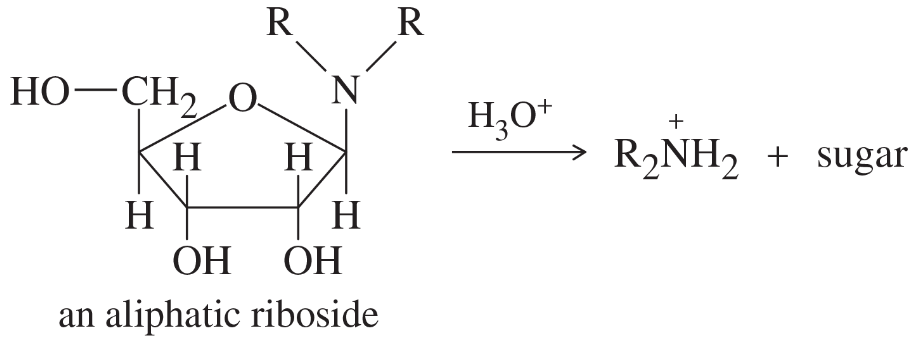
An aliphatic aminoglycoside is relatively stable to base, but it is quickly hydrolyzed by dilute acid. Propose a mechanism for the acid-catalyzed hydrolysis.

Verified step by step guidance
1
Step 1: Recognize that the reaction involves acid-catalyzed hydrolysis of an aliphatic aminoglycoside. The structure provided shows a glycosidic bond between a sugar moiety and an amine group (R2N). Acid catalysis typically involves protonation of the oxygen atom in the glycosidic bond, making it more susceptible to cleavage.
Step 2: Protonation occurs at the oxygen atom of the glycosidic bond by hydronium ion (H3O+). This increases the electrophilicity of the carbon atom attached to the oxygen, making it more prone to nucleophilic attack or bond cleavage.
Step 3: The protonated glycosidic bond undergoes cleavage. The bond between the sugar and the amine group breaks, resulting in the formation of a positively charged amine (R2NH2+) and a sugar molecule. This step is facilitated by the acidic environment.
Step 4: The sugar molecule formed may undergo further protonation or rearrangement depending on the reaction conditions, but the primary products are the free sugar and the protonated amine group.
Step 5: The mechanism highlights the role of acid in destabilizing the glycosidic bond and promoting hydrolysis. This explains why the aminoglycoside is stable in base but hydrolyzed quickly in acid.

Verified video answer for a similar problem:

This video solution was recommended by our tutors as helpful for the problem above.
Video duration:
4m
Was this helpful?

Key Concepts

Here are the essential concepts you must grasp in order to answer the question correctly.

Acid-Catalyzed Hydrolysis

Acid-catalyzed hydrolysis is a reaction where an acid donates protons (H+) to facilitate the breaking of chemical bonds in a molecule, leading to the formation of new products. In the case of aminoglycosides, the presence of hydronium ions (H3O+) enhances the nucleophilicity of water, allowing it to attack the glycosidic bond, resulting in the cleavage of the molecule into simpler components, such as sugar and an amine.
Recommended video:
Guided course
03:09
Acid Catalyzed

Aminoglycosides Structure

Aminoglycosides are a class of antibiotics characterized by their amino sugar components and glycosidic linkages. Their structure typically includes one or more amino groups attached to sugar moieties, which are crucial for their biological activity. Understanding the structural features of aminoglycosides is essential for predicting their reactivity, particularly how they respond to acidic conditions during hydrolysis.
Recommended video:
Guided course
03:04
Drawing Resonance Structures

Mechanism of Hydrolysis

The mechanism of hydrolysis involves a series of steps where the acid protonates the leaving group, making it a better leaving entity. This is followed by the nucleophilic attack of water on the electrophilic carbon, leading to the formation of a carbocation intermediate. The subsequent steps involve the breakdown of the carbocation and the release of the products, which in this case are a sugar and a protonated amine (R2NH2+).
Recommended video:
0:55
Hydrolysis of Nucleosides Concept 1
Related Practice
Textbook Question

Cellulose is converted to cellulose acetate by treatment with acetic anhydride and pyridine. Cellulose acetate is soluble in common organic solvents, and it is easily dissolved and spun into fibers. Show the structure of cellulose acetate.

149
views
Textbook Question

Cytosine, uracil, and guanine have tautomeric forms with aromatic hydroxy groups. Draw these tautomeric forms.

1050
views
Textbook Question

Ribonucleosides are not so easily hydrolyzed, requiring relatively strong acid. Using your mechanism for part (a), show why cytidine and adenosine (for example) are not so readily hydrolyzed. Explain why this stability is important for living organisms.

842
views
Textbook Question

Raffinose is a trisaccharide (C18H32O16) isolated from cottonseed meal. Raffinose does not reduce Tollens reagent, and it does not mutarotate. Complete hydrolysis of raffinose gives D-glucose, D-fructose, and D-galactose. When raffinose is treated with invertase, the products are D-fructose and a reducing disaccharide called melibiose. Raffinose is unaffected by treatment with a β-galactosidase, but an α-galactosidase hydrolyzes it to D-galactose and sucrose. When raffinose is treated with dimethyl sulfate and base followed by hydrolysis, the products are 2,3,4-tri-O-methylglucose, 1,3,4,6-tetra-O-methylfructose, and 2,3,4,6-tetra-O-methylgalactose. Determine the complete structures of raffinose and melibiose, and give a systematic name for melibiose.

1467
views
Textbook Question

Glucose is the most abundant monosaccharide. From memory, draw glucose in

(a) the Fischer projection of the open chain.

(b) the most stable chair conformation of the most stable pyranose anomer.

(c) the Haworth projection of the most stable pyranose anomer.

1315
views
Textbook Question

All of the rings of the four heterocyclic bases are aromatic. This is more apparent when the polar resonance forms of the amide groups are drawn, as is done for thymine here. Redraw the hydrogen-bonded guanine-cytosine and adenine-thymine pairs shown in Figure 23-24, using the polar resonance forms of the amides. Show how these forms help to explain why the hydrogen bonds involved in these pairings are particularly strong. Remember that a hydrogen bond arises between an electron-deficient hydrogen atom and an electron-rich pair of nonbonding electrons.

627
views