Ch. 23 - Carbohydrates and Nucleic Acids
Wade - Organic Chemistry 9th Edition
Wade9th EditionOrganic ChemistryISBN: 9780135213728Not the one you use?Change textbook
Chapter 23, Problem 50

(a) Give the products expected when (+)-glyceraldehyde reacts with HCN.
(b) What is the relationship between the products? How might they be separated?
(c) Are the products optically active? Explain.

Verified step by step guidance
1
Step 1: Understand the reaction of (+)-glyceraldehyde with HCN. (+)-Glyceraldehyde is an aldehyde with a hydroxyl group on the second carbon. When it reacts with HCN, the cyanide ion (CN⁻) acts as a nucleophile and attacks the carbonyl carbon of the aldehyde group, forming a cyanohydrin. This reaction creates a new chiral center at the carbon that was originally part of the carbonyl group.
Step 2: Predict the products. Since the attack of the cyanide ion on the planar carbonyl group can occur from either side, two stereoisomers (enantiomers) of the cyanohydrin will be formed. These enantiomers are mirror images of each other and are non-superimposable.
Step 3: Determine the relationship between the products. The two products are enantiomers, which means they are stereoisomers that are mirror images of each other. Enantiomers have identical physical properties (e.g., boiling point, melting point) except for their interaction with plane-polarized light and their behavior in a chiral environment.
Step 4: Discuss how the products might be separated. Since the products are enantiomers, they can be separated using chiral resolution techniques. One common method is to react the mixture with a chiral resolving agent to form diastereomers, which have different physical properties and can be separated by conventional methods such as crystallization or chromatography.
Step 5: Address optical activity of the products. Each individual enantiomer is optically active because it can rotate plane-polarized light. However, if the reaction produces an equal mixture of the two enantiomers (a racemic mixture), the optical activities of the enantiomers cancel each other out, and the mixture as a whole will not be optically active.

Verified video answer for a similar problem:

This video solution was recommended by our tutors as helpful for the problem above.
Video duration:
4m
Was this helpful?

Key Concepts

Here are the essential concepts you must grasp in order to answer the question correctly.

Nucleophilic Addition

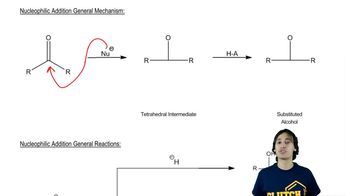
Nucleophilic addition is a fundamental reaction in organic chemistry where a nucleophile attacks an electrophilic carbon atom, leading to the formation of a new bond. In the case of glyceraldehyde reacting with HCN, the cyanide ion (CN-) acts as the nucleophile, attacking the carbonyl carbon of glyceraldehyde, resulting in the formation of a cyanohydrin.
Recommended video:
Guided course
08:27
Nucleophilic Addition

Stereochemistry and Optical Activity

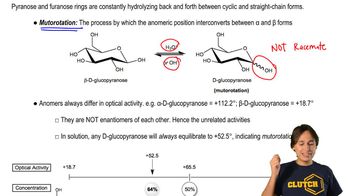
Stereochemistry refers to the spatial arrangement of atoms in molecules and how this affects their chemical behavior. The products of the reaction between glyceraldehyde and HCN can lead to the formation of chiral centers, which can result in optical isomers (enantiomers). Optical activity is the ability of a compound to rotate plane-polarized light, a property that is significant for chiral molecules.
Recommended video:
Guided course
08:17
Mutorotation and Optical Activity

Separation Techniques

Separation techniques are methods used to isolate and purify compounds from a mixture. In the context of the products formed from glyceraldehyde and HCN, techniques such as chromatography or recrystallization can be employed to separate the resulting cyanohydrin products based on their differing physical properties, such as solubility or polarity.
Recommended video:
Guided course
05:41
Reason for Analytical Methods