
Ch. 23 - Carbohydrates and Nucleic Acids
Wade - Organic Chemistry 9th Edition
Wade9th EditionOrganic ChemistryISBN: 9780135213728Not the one you use?Change textbook
Chapter 23, Problem 31

D-Altrose is an aldohexose. Ruff degradation of D-altrose gives the same aldopentose as does degradation of D-allose, the C3 epimer of glucose. Give the structure of D-altrose.

Verified step by step guidance
1
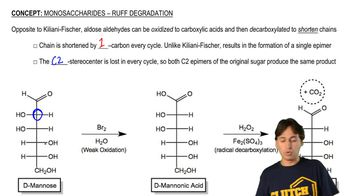
Understand the problem: D-Altrose is an aldohexose, meaning it is a six-carbon sugar with an aldehyde group. Ruff degradation involves the oxidation of the aldehyde group to a carboxylic acid, followed by decarboxylation, which shortens the sugar chain by one carbon. The problem asks us to determine the structure of D-Altrose based on the fact that its Ruff degradation gives the same aldopentose as D-Allose, the C3 epimer of glucose.
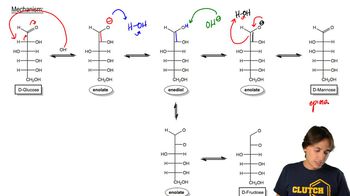
Step 1: Recall the structure of D-Allose. D-Allose is an aldohexose and the C3 epimer of D-Glucose. This means that the configuration of the hydroxyl group on carbon 3 (C3) is inverted compared to D-Glucose. Write out the Fischer projection of D-Allose: the hydroxyl groups on C2, C3, C4, and C5 are in the following order: right, left, right, right.
Step 2: Perform Ruff degradation on D-Allose. Ruff degradation removes the carbon at the aldehyde end (C1) and shortens the chain by one carbon. This results in an aldopentose. The aldopentose formed from D-Allose will have the same stereochemistry at C2, C3, and C4 as the original D-Allose at C2, C3, and C4. Write out the Fischer projection of the resulting aldopentose.
Step 3: Analyze the relationship between D-Altrose and D-Allose. D-Altrose is described as giving the same aldopentose as D-Allose upon Ruff degradation. This means that D-Altrose must have the same stereochemistry at C2, C3, and C4 as D-Allose, since these carbons correspond to C2, C3, and C4 of the aldopentose after degradation.
Step 4: Construct the Fischer projection of D-Altrose. Since D-Altrose is an aldohexose, it has six carbons. The stereochemistry at C2, C3, and C4 must match that of D-Allose. The only difference between D-Altrose and D-Allose will be at C5, as this carbon does not affect the aldopentose formed during Ruff degradation. Assign the hydroxyl group on C5 to the left (opposite of D-Allose) to complete the structure of D-Altrose.

Verified video answer for a similar problem:

This video solution was recommended by our tutors as helpful for the problem above.
Video duration:
5m
Was this helpful?

Key Concepts

Here are the essential concepts you must grasp in order to answer the question correctly.

Aldoses and Ketoses

Aldoses are carbohydrates that contain an aldehyde group (-CHO) at one end of the molecule, while ketoses have a ketone group (C=O) within the carbon chain. Understanding the distinction between these two types of sugars is crucial for identifying their structures and reactivity. D-altrose, being an aldohexose, falls under the category of aldoses, which influences its chemical behavior and degradation pathways.
Recommended video:

Epimerization

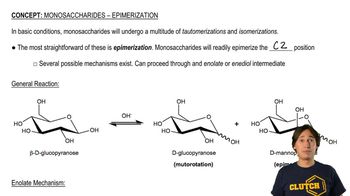
Epimerization refers to the process where two sugars differ in configuration at only one specific carbon atom. In this case, D-altrose and D-allose are C3 epimers, meaning they differ at the third carbon. This concept is essential for understanding how structural variations in sugars can lead to different properties and reactions, including the degradation processes mentioned in the question.
Recommended video:
Guided course
02:57
General Reaction

Ruff Degradation

Ruff degradation is a chemical reaction that involves the oxidative cleavage of aldoses to produce smaller sugar units. This process is significant in carbohydrate chemistry as it helps in determining the structure of sugars by revealing their breakdown products. In the context of D-altrose and D-allose, recognizing that they yield the same aldopentose upon Ruff degradation is key to deducing their structural similarities and differences.
Recommended video:
Guided course
06:18
Monosaccharides - Ruff Degradation
Related Practice
Textbook Question

In 1891, Emil Fischer determined the structures of glucose and the seven other D-aldohexoses using only simple chemical reactions and clever reasoning about stereochemistry and symmetry. He received the Nobel Prize for this work in 1902. Fischer had determined that D-glucose is an aldohexose, and he used Ruff degradations to degrade it to (+)-glyceraldehyde. Therefore, the eight D-aldohexose structures shown in Figure 23-3 are the possible structures for glucose.

Pretend that no names are shown in Figure 23-3 except for glyceraldehyde, and use the following results to prove which of these structures represent glucose, mannose, arabinose, and erythrose.

(a) Upon Ruff degradation, glucose and mannose give the same aldopentose: arabinose. Nitric acid oxidation of arabinose gives an optically active aldaric acid. What are the two possible structures of arabinose?

895
views
Textbook Question

The Wohl degradation, an alternative to the Ruff degradation, is nearly the reverse of the Kiliani–Fischer synthesis. The aldose carbonyl group is converted to the oxime, which is dehydrated by acetic anhydride to the nitrile (a cyanohydrin). Cyanohydrin formation is reversible, and a basic hydrolysis allows the cyanohydrin to lose HCN. Using the following sequence of reagents, give equations for the individual reactions in the Wohl degradation of D-arabinose to D-erythrose. Mechanisms are not required.

a. hydroxylamine hydrochloride

b. acetic anhydride

c. OH, H2O

1777
views
Textbook Question

Ruff degradation of D-arabinose gives D-erythrose. The Kiliani–Fischer synthesis converts D-erythrose to a mixture of D-arabinose and D-ribose. Draw out these reactions, and give the structure of D-ribose.

1049
views
Textbook Question

Show that Ruff degradation of D-mannose gives the same aldopentose (D-arabinose) as does D-glucose.

1651
views
1
rank
Textbook Question

D-Lyxose is formed by Ruff degradation of galactose. Give the structure of D-lyxose. Ruff degradation of D-lyxose gives D-threose. Give the structure of D-threose.

1233
views
Textbook Question

Predict the products formed when the following sugars react with excess acetic anhydride and pyridine.

(b) β-D-ribofuranose

583
views