Ch. 23 - Carbohydrates and Nucleic Acids
Wade - Organic Chemistry 9th Edition
Wade9th EditionOrganic ChemistryISBN: 9780135213728Not the one you use?Change textbook
Chapter 23, Problem 21c

Draw the structures of the compound ethyl β-D-ribofuranoside.
Allose is the C3 epimer of glucose, and ribose is the C2 epimer of arabinose.

Verified step by step guidance
1
Understand the problem: The task is to draw the structure of ethyl β-D-ribofuranoside. This involves understanding the structure of ribose, its furanose form, and the β-glycosidic bond with an ethyl group. Additionally, the problem mentions epimers, which are sugars that differ in configuration at a single stereogenic center.
Step 1: Recall the structure of D-ribose. D-ribose is a five-carbon aldose sugar (an aldopentose) with the molecular formula C₅H₁₀O₅. In its Fischer projection, the hydroxyl groups on carbons 2, 3, and 4 are arranged as follows: OH on the right (C2), OH on the right (C3), and OH on the right (C4).
Step 2: Convert D-ribose into its furanose form. In aqueous solution, D-ribose cyclizes to form a five-membered ring (furanose) by the reaction of the hydroxyl group on C4 with the aldehyde group on C1. This forms a hemiacetal. The β-anomer is formed when the hydroxyl group on C1 is oriented above the plane of the ring in the Haworth projection.
Step 3: Add the ethyl group to form ethyl β-D-ribofuranoside. The ethyl group replaces the hydrogen of the hydroxyl group on C1, forming a glycosidic bond. This results in the structure of ethyl β-D-ribofuranoside, where the ethyl group is attached to the anomeric carbon (C1) and the β-configuration is maintained.
Step 4: Verify the stereochemistry and draw the final structure. Ensure that the stereochemistry of the hydroxyl groups on C2, C3, and C4 matches that of D-ribose in the furanose form. The β-glycosidic bond should have the ethyl group pointing above the plane of the ring in the Haworth projection.

Verified video answer for a similar problem:

This video solution was recommended by our tutors as helpful for the problem above.
Video duration:
3m
Was this helpful?

Key Concepts

Here are the essential concepts you must grasp in order to answer the question correctly.

Furanose Structure

Furanose refers to a five-membered ring structure formed by the cyclization of sugars. In the case of ribofuranoside, the ribose sugar forms a furanose ring when the hydroxyl group on the C1 carbon reacts with the hydroxyl group on the C4 carbon. Understanding this structure is crucial for drawing the correct representation of ethyl b-D-ribofuranoside.
Recommended video:
Guided course
03:04
Drawing Resonance Structures

Epimerization

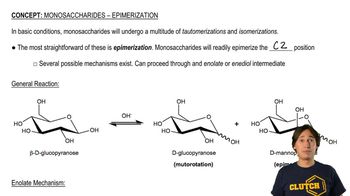
Epimerization is the process by which two sugars differ in configuration at only one specific carbon atom. In the context of the question, allose is an epimer of glucose at the C3 position, while ribose is an epimer of arabinose at the C2 position. Recognizing these relationships helps in understanding the structural differences between these sugars.
Recommended video:
Guided course
02:57
General Reaction

Glycosidic Bond Formation

A glycosidic bond is formed when a sugar reacts with an alcohol, resulting in the formation of an ether linkage. In the case of ethyl b-D-ribofuranoside, the hydroxyl group on the anomeric carbon of ribofuranose reacts with ethanol to form this bond. This concept is essential for accurately depicting the final structure of the compound.
Recommended video:
2:01
Disulfide Bonds Concept 1