Cellulose is converted to cellulose acetate by treatment with acetic anhydride and pyridine. Cellulose acetate is soluble in common organic solvents, and it is easily dissolved and spun into fibers. Show the structure of cellulose acetate.
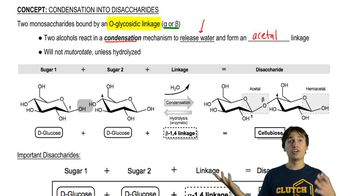
Trehalose is a nonreducing disaccharide (C12H22O11) isolated from the poisonous mushroom Amanita muscaria. Treatment with an α-glucosidase converts trehalose to two molecules of glucose, but no reaction occurs when trehalose is treated with a β-glucosidase. When trehalose is methylated by dimethyl sulfate in mild base and then hydrolyzed, the only product is 2,3,4,6-tetra-O-methylglucose. Propose a complete structure and systematic name for trehalose.
Verified step by step guidance
Verified video answer for a similar problem:
Key Concepts
Disaccharides
Glycosidic Bonds
Methylation and Hydrolysis
Give an equation to show the reduction of Tollens reagent by maltose.
Cytosine, uracil, and guanine have tautomeric forms with aromatic hydroxy groups. Draw these tautomeric forms.
Raffinose is a trisaccharide (C18H32O16) isolated from cottonseed meal. Raffinose does not reduce Tollens reagent, and it does not mutarotate. Complete hydrolysis of raffinose gives D-glucose, D-fructose, and D-galactose. When raffinose is treated with invertase, the products are D-fructose and a reducing disaccharide called melibiose. Raffinose is unaffected by treatment with a β-galactosidase, but an α-galactosidase hydrolyzes it to D-galactose and sucrose. When raffinose is treated with dimethyl sulfate and base followed by hydrolysis, the products are 2,3,4-tri-O-methylglucose, 1,3,4,6-tetra-O-methylfructose, and 2,3,4,6-tetra-O-methylgalactose. Determine the complete structures of raffinose and melibiose, and give a systematic name for melibiose.

Is gentiobiose a reducing sugar? Does it mutarotate? Explain your reasoning
Does lactose mutarotate? Is it a reducing sugar? Explain. Draw the two anomeric forms of lactose