Ch. 24 - Amino Acids, Peptides, and Proteins
Wade - Organic Chemistry 9th Edition
Wade9th EditionOrganic ChemistryISBN: 9780135213728Not the one you use?Change textbook
Chapter 24, Problem 13

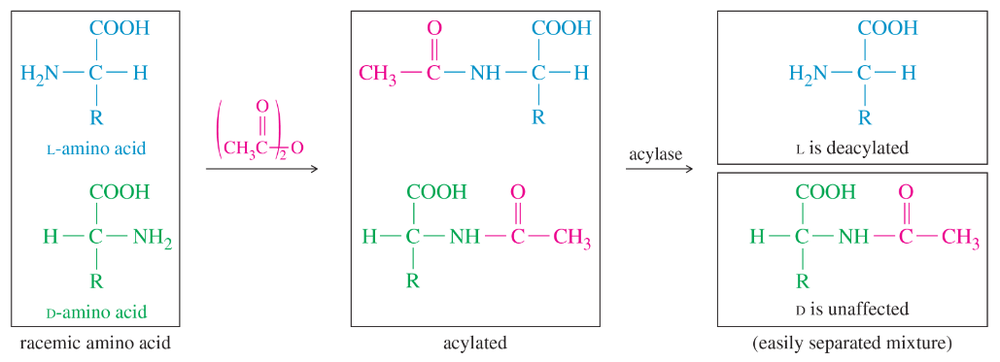
Suggest how you would separate the free L-amino acid from its acylated D enantiomer in Figure 24-5.

Verified step by step guidance
1
Analyze the problem: The goal is to separate the free L-amino acid from its acylated D-enantiomer. This involves exploiting differences in their physical or chemical properties, such as solubility, reactivity, or chirality.
Step 1: Consider the chirality of the molecules. Since the L-amino acid and the acylated D-enantiomer are stereoisomers, they may interact differently with a chiral resolving agent or a chiral stationary phase in chromatography.
Step 2: Use a chiral chromatography technique. Employ a chiral stationary phase in high-performance liquid chromatography (HPLC) or gas chromatography (GC) to separate the two enantiomers based on their differential interactions with the chiral environment.
Step 3: Alternatively, consider chemical resolution. React the mixture with a chiral reagent that selectively reacts with one enantiomer (e.g., the free L-amino acid) to form a diastereomeric product. Diastereomers have different physical properties and can be separated by conventional methods like crystallization or chromatography.
Step 4: After separation, if a chemical resolution method was used, regenerate the original L-amino acid by reversing the reaction with the chiral reagent. For example, hydrolyze the diastereomeric product to recover the free L-amino acid.

Verified video answer for a similar problem:

This video solution was recommended by our tutors as helpful for the problem above.
Video duration:
3m
Was this helpful?

Key Concepts

Here are the essential concepts you must grasp in order to answer the question correctly.

Enantiomers

Enantiomers are a type of stereoisomer that are non-superimposable mirror images of each other. They have identical physical properties in an achiral environment but can exhibit different behaviors in chiral environments, such as biological systems. Understanding the concept of enantiomers is crucial for separating compounds based on their chirality.
Recommended video:
Guided course
03:23
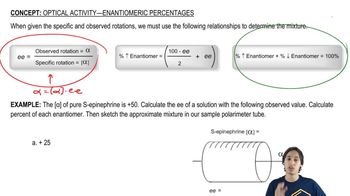
How to solve for the percentage of each enantiomer.

Acylation

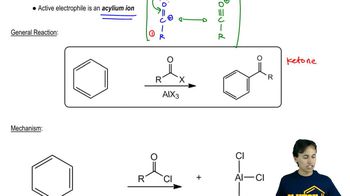
Acylation is a chemical reaction that introduces an acyl group into a molecule, often enhancing its reactivity or solubility. In the context of amino acids, acylation can modify their properties, making it possible to differentiate between the acylated and free forms. Recognizing how acylation affects the physical and chemical properties of amino acids is essential for separation techniques.
Recommended video:
Guided course
05:20
Friedel-Crafts Acylation

Chromatography

Chromatography is a widely used technique for separating components in a mixture based on their different affinities for a stationary phase and a mobile phase. Techniques such as chiral chromatography can effectively separate enantiomers by exploiting their differing interactions with chiral stationary phases. Understanding chromatography principles is vital for devising a method to separate the free l-amino acid from its acylated D enantiomer.
Recommended video:
3:10
Peptide Sequencing: Edman Degradation Concept 1