Ch.3 - Structure and Stereochemistry of Alkanes
Wade - Organic Chemistry 9th Edition
Wade9th EditionOrganic ChemistryISBN: 9780135213728Not the one you use?Change textbook
Chapter 3, Problem 36a,b

Draw the structure that corresponds with each name.
a. 3-ethyloctane
b. 4-isopropyldecane

Verified step by step guidance
1
Step 1: Understand the basic structure of alkanes. Alkanes are saturated hydrocarbons with the general formula CnH2n+2. They consist of carbon atoms connected by single bonds, with hydrogen atoms filling the remaining valences.
Step 2: For 3-ethyloctane, start by drawing the main chain. Octane indicates a straight chain of 8 carbon atoms. Number these carbon atoms from 1 to 8.
Step 3: Identify the substituent group for 3-ethyloctane. The 'ethyl' group is a two-carbon substituent, CH2CH3. Attach this ethyl group to the third carbon atom in the octane chain.
Step 4: For 4-isopropyldecane, begin by drawing the main chain. Decane indicates a straight chain of 10 carbon atoms. Number these carbon atoms from 1 to 10.
Step 5: Identify the substituent group for 4-isopropyldecane. The 'isopropyl' group is a three-carbon substituent, (CH3)2CH. Attach this isopropyl group to the fourth carbon atom in the decane chain.

Verified video answer for a similar problem:

This video solution was recommended by our tutors as helpful for the problem above.
Video duration:
2m
Was this helpful?

Key Concepts

Here are the essential concepts you must grasp in order to answer the question correctly.

IUPAC Nomenclature

IUPAC nomenclature is a systematic method of naming organic chemical compounds as recommended by the International Union of Pure and Applied Chemistry. It ensures that each compound has a unique name, which describes its structure. Understanding the rules of IUPAC nomenclature is essential for interpreting and drawing chemical structures from names.
Recommended video:
Guided course
03:43
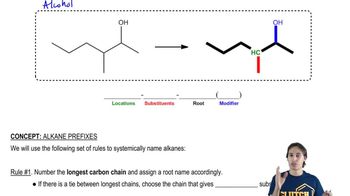
The different parts of an IUPAC name

Alkane Structure

Alkanes are saturated hydrocarbons consisting of carbon and hydrogen atoms with single bonds. Their general formula is CnH2n+2. Recognizing the structure of alkanes, including straight-chain and branched forms, is crucial for drawing compounds like 3-ethyloctane and 4-isopropyldecane, which involve specific branching at designated carbon atoms.
Recommended video:
Guided course
02:47
Functionalizing Alkanes

Substituent Positioning

Substituent positioning refers to the location of groups attached to the main carbon chain in a molecule. In organic chemistry, the position is indicated by numbers, which correspond to the carbon atom in the chain. For example, in 3-ethyloctane, the ethyl group is attached to the third carbon, while in 4-isopropyldecane, the isopropyl group is attached to the fourth carbon, affecting the molecule's structure.
Recommended video:
4:06
Reactions at the Allylic Position Example 3