
Ch.3 - Structure and Stereochemistry of Alkanes
Wade - Organic Chemistry 9th Edition
Wade9th EditionOrganic ChemistryISBN: 9780135213728Not the one you use?Change textbook
Chapter 3, Problem 8c

Draw the structures of the following compounds.
c. 3,3-diethyl-4-(2,2-dimethylpropyl)octane

Verified step by step guidance
1
Identify the parent chain: The parent chain is 'octane', which means it has 8 carbon atoms in a continuous chain.
Number the carbon atoms in the parent chain: Start numbering from the end closest to the first substituent to ensure the lowest possible numbers for the substituents.
Locate and attach the substituents: At carbon 3, attach two ethyl groups (3,3-diethyl). At carbon 4, attach a 2,2-dimethylpropyl group.
Draw the substituents: An ethyl group is -CH2CH3, and a 2,2-dimethylpropyl group is a three-carbon chain with two methyl groups attached to the second carbon.
Combine the structure: Ensure all substituents are correctly attached to the main chain, and verify that the total number of carbon atoms matches the name of the compound.

Verified video answer for a similar problem:

This video solution was recommended by our tutors as helpful for the problem above.
Video duration:
1m
Was this helpful?

Key Concepts

Here are the essential concepts you must grasp in order to answer the question correctly.

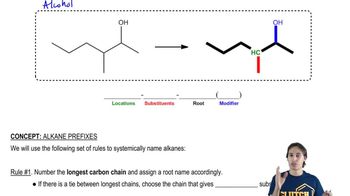
IUPAC Nomenclature

IUPAC nomenclature is a systematic method of naming organic chemical compounds as recommended by the International Union of Pure and Applied Chemistry. It provides a standardized way to name compounds based on their structure, ensuring that each name is unique and descriptive. Understanding IUPAC rules is essential for interpreting and drawing chemical structures from names.
Recommended video:
Guided course
03:43
The different parts of an IUPAC name

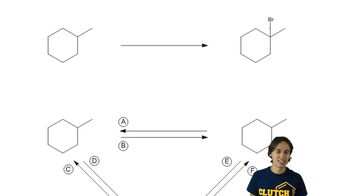
Alkane Structure

Alkanes are hydrocarbons with only single bonds between carbon atoms, forming a saturated chain. The general formula for alkanes is CnH2n+2. Understanding the structure of alkanes, including straight chains and branched chains, is crucial for drawing and identifying compounds like octane, which is a straight-chain alkane with eight carbon atoms.
Recommended video:
Guided course
02:47
Functionalizing Alkanes

Substituents in Organic Chemistry

Substituents are atoms or groups of atoms that replace hydrogen atoms in a hydrocarbon chain. They are named and positioned according to their location on the main carbon chain. In the given compound, '3,3-diethyl' and '4-(2,2-dimethylpropyl)' are substituents that modify the octane chain, and understanding their placement is key to drawing the correct structure.
Recommended video:
Guided course
00:56
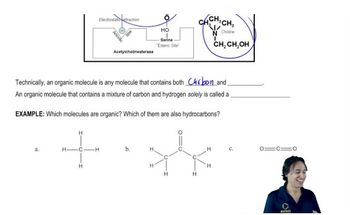
What is an organic molecule?