Ch.3 - Structure and Stereochemistry of Alkanes
Wade - Organic Chemistry 9th Edition
Wade9th EditionOrganic ChemistryISBN: 9780135213728Not the one you use?Change textbook
Chapter 3, Problem 4a,b,c

Provide IUPAC names for the following compounds.
a. (CH3)2CHCH2CH3
b. CH3—C(CH3)2—CH3
c.

Verified step by step guidance
1
Step 1: Identify the longest continuous carbon chain in each compound. This will determine the base name of the compound according to the number of carbon atoms.
Step 2: For compound (a), (CH3)2CHCH2CH3, the longest chain is 5 carbons long, which corresponds to 'pentane'.
Step 3: For compound (b), CH3—C(CH3)2—CH3, the longest chain is 3 carbons long, which corresponds to 'propane'.
Step 4: For compound (c), identify the longest chain, which is 6 carbons long, corresponding to 'hexane'.
Step 5: Determine the substituents attached to the main chain and their positions. For compound (a), there is a methyl group on the second carbon. For compound (b), there are two methyl groups on the second carbon. For compound (c), there is an ethyl group on the third carbon and two methyl groups on the fourth carbon.

Verified video answer for a similar problem:

This video solution was recommended by our tutors as helpful for the problem above.
Video duration:
9m
Was this helpful?

Key Concepts

Here are the essential concepts you must grasp in order to answer the question correctly.

IUPAC Nomenclature

IUPAC nomenclature is a systematic method for naming organic chemical compounds. It provides rules for identifying the longest carbon chain, determining the position of substituents, and assigning numbers to ensure clarity. Understanding these rules is essential for accurately naming compounds based on their structure.
Recommended video:
Guided course
03:43
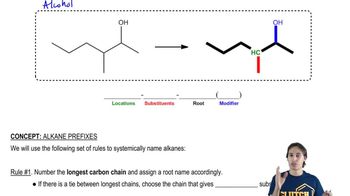
The different parts of an IUPAC name

Alkane Structure

Alkanes are saturated hydrocarbons consisting only of carbon and hydrogen atoms, connected by single bonds. Their general formula is CnH2n+2, where 'n' is the number of carbon atoms. Recognizing the structure of alkanes helps in identifying the backbone of the molecule and the placement of substituents for proper naming.
Recommended video:
Guided course
02:47
Functionalizing Alkanes

Substituents and Branching

Substituents are groups of atoms that replace hydrogen atoms in a hydrocarbon chain. In branched alkanes, the presence of substituents affects the naming convention, as the longest continuous chain must be identified first. Understanding how to recognize and name these substituents is crucial for deriving the correct IUPAC name.
Recommended video:
Guided course
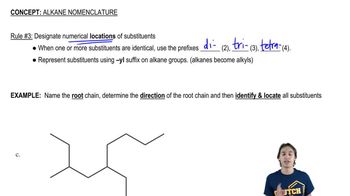
03:07
How to identify and locate branches (substituents)