Ch.3 - Structure and Stereochemistry of Alkanes
Wade - Organic Chemistry 9th Edition
Wade9th EditionOrganic ChemistryISBN: 9780135213728Not the one you use?Change textbook
Chapter 3, Problem 21

The cyclohexane chair shown in Figure 3-22 has the headrest to the right and the footrest to the left. Draw a cyclohexane chair with its axial and equatorial bonds, showing the headrest to the left and the footrest to the right.

Verified step by step guidance
1
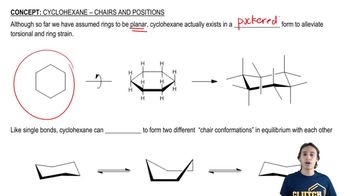
Step 1: Understand the cyclohexane chair conformation. Cyclohexane adopts a chair conformation to minimize steric strain and torsional strain. In this conformation, the carbon atoms alternate between being slightly above and below the plane of the ring, creating a 'headrest' and 'footrest' appearance.
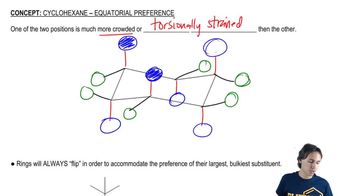
Step 2: Identify the axial and equatorial positions. In the chair conformation, each carbon atom has one axial bond (pointing straight up or down, perpendicular to the plane of the ring) and one equatorial bond (pointing outward, roughly parallel to the plane of the ring). These positions alternate around the ring.
Step 3: Reverse the orientation of the chair conformation. To draw the chair with the headrest to the left and the footrest to the right, flip the structure horizontally. This involves swapping the positions of the carbons while maintaining the alternating axial and equatorial bonds.
Step 4: Assign axial and equatorial bonds correctly. After flipping the chair, ensure that the axial bonds still alternate up and down around the ring, and the equatorial bonds remain roughly parallel to the plane of the ring. Use dashed and solid lines to distinguish between axial and equatorial bonds.
Step 5: Label the carbons and verify the structure. Number the carbons in the flipped chair conformation (1 through 6) to match the original numbering system. Double-check that the headrest is now on the left and the footrest is on the right, and that the axial and equatorial bonds are correctly positioned.

Verified video answer for a similar problem:

This video solution was recommended by our tutors as helpful for the problem above.
Video duration:
1m
Was this helpful?

Key Concepts

Here are the essential concepts you must grasp in order to answer the question correctly.

Cyclohexane Chair Conformation

The cyclohexane chair conformation is a three-dimensional structure that minimizes steric strain in cyclohexane rings. In this conformation, the carbon atoms are arranged in a staggered manner, allowing for more stable interactions between substituents. The chair form is the most stable conformation of cyclohexane due to its ability to avoid eclipsing interactions.
Recommended video:
Guided course
01:05
What is a chair conformation?

Axial and Equatorial Bonds

In the chair conformation of cyclohexane, substituents can occupy two types of positions: axial and equatorial. Axial bonds are oriented vertically, alternating up and down around the ring, while equatorial bonds extend outward from the ring, providing more space. The positioning of substituents affects the stability of the molecule, with equatorial positions generally being more favorable for larger groups.
Recommended video:
Guided course
04:02
Equatorial Preference

Drawing Chair Conformations

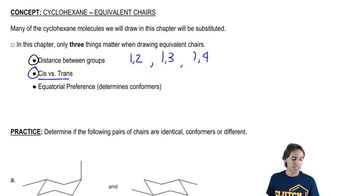
When drawing chair conformations, it is essential to accurately represent the axial and equatorial bonds. The headrest and footrest orientation must be clearly indicated, as they determine the overall structure. Properly labeling the carbon atoms and ensuring the correct bond angles will help visualize the spatial arrangement of substituents, which is crucial for understanding reactivity and stability.
Recommended video:
Guided course
05:12
The 3 important factors when drawing chairs