
Conformational studies on ethane-1,2-diol (HOCH2–CH2OH) have shown the most stable conformation about the central C―C bond to be the gauche conformation, which is 9.6 kJ/mol (2.3 kcal/mol) more stable than the anti conformation. Draw Newman projections of these conformers, and explain this curious result.
Ch.3 - Structure and Stereochemistry of Alkanes
Chapter 3, Problem 51
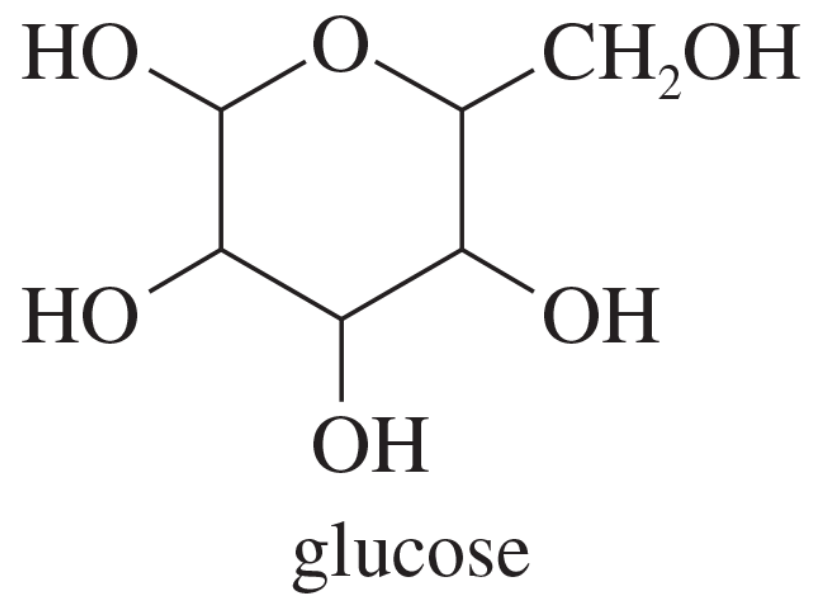
The most stable form of the common sugar glucose contains a six-membered ring in the chair conformation with all the substituents equatorial. Draw this most stable conformation of glucose.

Verified step by step guidance1
Identify the structure of glucose: Glucose is a six-carbon sugar with the molecular formula C6H12O6. In its most stable form, it adopts a six-membered ring structure known as a pyranose form.
Understand the chair conformation: The chair conformation is a three-dimensional shape that cyclohexane rings can adopt to minimize steric strain. In this conformation, substituents can be in axial (up or down) or equatorial (around the equator of the ring) positions.
Determine the orientation of substituents: For glucose, the most stable conformation is when all the hydroxyl (OH) groups and the CH2OH group are in equatorial positions to minimize steric hindrance and maximize stability.
Draw the chair conformation: Start by sketching a cyclohexane chair structure. Place the oxygen atom in the ring and arrange the carbon atoms around it. Ensure that all substituents (OH groups and CH2OH) are positioned equatorially.
Verify the structure: Double-check that all substituents are in the equatorial position and that the overall structure represents the most stable form of glucose. This ensures that the drawing accurately reflects the most stable conformation.

Verified video answer for a similar problem:
This video solution was recommended by our tutors as helpful for the problem above.
Video duration:
3mWas this helpful?
Key Concepts
Here are the essential concepts you must grasp in order to answer the question correctly.
Chair Conformation
The chair conformation is a three-dimensional shape that cyclohexane rings adopt to minimize steric strain and torsional strain. In this conformation, the carbon atoms are arranged in a staggered manner, resembling a chair, which allows for the most stable arrangement of atoms and substituents. This conformation is crucial for understanding the stability of glucose in its most stable form.
Recommended video:
Guided course
Understanding what a conformer is.
Equatorial Position
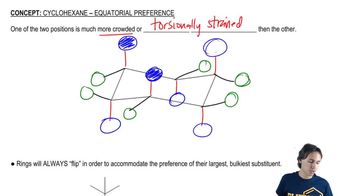
In cyclohexane rings, substituents can occupy either axial or equatorial positions. Equatorial positions are located around the equator of the ring and are generally more stable due to reduced steric hindrance compared to axial positions. For glucose, having all substituents in equatorial positions minimizes steric clashes, contributing to its stability.
Recommended video:
Guided course
Equatorial Preference
Glucose Structure
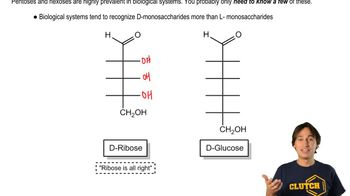
Glucose is a six-carbon sugar with an aldehyde group and five hydroxyl groups. In its most stable form, glucose adopts a pyranose ring structure, resembling a cyclohexane ring in the chair conformation. Understanding the arrangement of hydroxyl groups and the ring structure is essential for drawing and recognizing the most stable conformation of glucose.
Recommended video:
Guided course
Monosaccharides - Common Structures
Related Practice
Textbook Question
1770
views
Textbook Question
This is a Newman projection of a substituted cyclohexane.
b. Draw the equivalent structure using wedge and dash notation on a cyclohexane hexagon.
3480
views
Textbook Question
Draw Newman projections along the C3―C4 bond to show the most stable and least stable conformations of 3-ethyl-2,4,4-trimethylheptane.
2235
views
Textbook Question
This is a Newman projection of a substituted cyclohexane. a. Draw the equivalent chair form.
1339
views
Textbook Question
Convert each Newman projection to the equivalent line–angle formula, and assign the IUPAC name. g.
(g)
(h)
2294
views
Textbook Question
This is a Newman projection of a substituted cyclohexane.
c. Give the IUPAC name.
1369
views
