
Ch.3 - Structure and Stereochemistry of Alkanes
Wade - Organic Chemistry 9th Edition
Wade9th EditionOrganic ChemistryISBN: 9780135213728Not the one you use?Change textbook
Chapter 3, Problem 47

Using what you know about the conformational energetics of substituted cyclohexanes, predict which of the two decalin isomers is more stable. Explain your reasoning.

Verified step by step guidance
1
Begin by understanding the structure of decalin, which consists of two fused cyclohexane rings. The two isomers shown are trans-decalin and cis-decalin.
Consider the conformational stability of cyclohexane rings. Cyclohexane prefers to adopt a chair conformation because it minimizes steric strain and torsional strain.
In trans-decalin, both cyclohexane rings can adopt a chair conformation without any steric hindrance between the axial positions of the rings. This allows for a more stable conformation.
In cis-decalin, one of the cyclohexane rings must adopt a less stable conformation due to steric interactions between the axial positions of the rings. This results in increased steric strain.
Therefore, trans-decalin is generally more stable than cis-decalin because it allows both rings to remain in their preferred chair conformation, minimizing steric and torsional strain.

Verified video answer for a similar problem:

This video solution was recommended by our tutors as helpful for the problem above.
Video duration:
1m
Was this helpful?

Key Concepts

Here are the essential concepts you must grasp in order to answer the question correctly.

Conformational Energetics

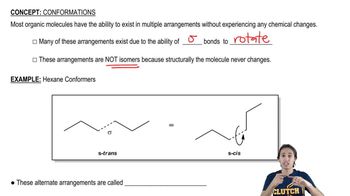
Conformational energetics refers to the study of energy differences between different spatial arrangements of atoms in a molecule. In cyclohexanes, the chair conformation is typically the most stable due to minimized steric strain and torsional strain. Substituents prefer equatorial positions over axial ones to reduce steric hindrance, affecting the overall stability of the molecule.
Recommended video:
Guided course
03:29
Understanding what a conformer is.

Trans vs. Cis Isomers

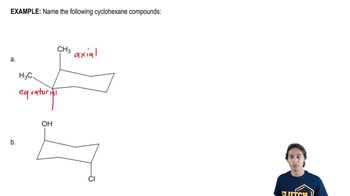
Trans and cis isomers differ in the spatial arrangement of substituents across a double bond or a ring system. In decalin derivatives, trans isomers have substituents on opposite sides, while cis isomers have them on the same side. Trans isomers generally exhibit lower steric strain and are more stable due to less crowding and better distribution of substituents.
Recommended video:
Guided course
00:44
Is the following cyclohexane cis or trans?

Steric Strain

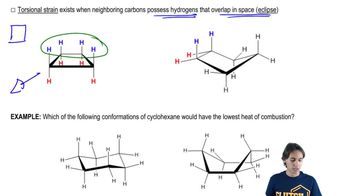
Steric strain arises from the repulsion between atoms or groups that are too close to each other, leading to increased energy and decreased stability. In cyclohexane derivatives, steric strain is minimized when bulky groups are positioned equatorially rather than axially, as axial positions can lead to unfavorable interactions with other axial hydrogens or groups.
Recommended video:
Guided course
02:00
What is torsional strain?