

Ch.4 - The Study of Chemical Reactions
Wade - Organic Chemistry 9th Edition
Wade9th EditionOrganic ChemistryISBN: 9780135213728Not the one you use?Change textbook
Chapter 4, Problem 57c

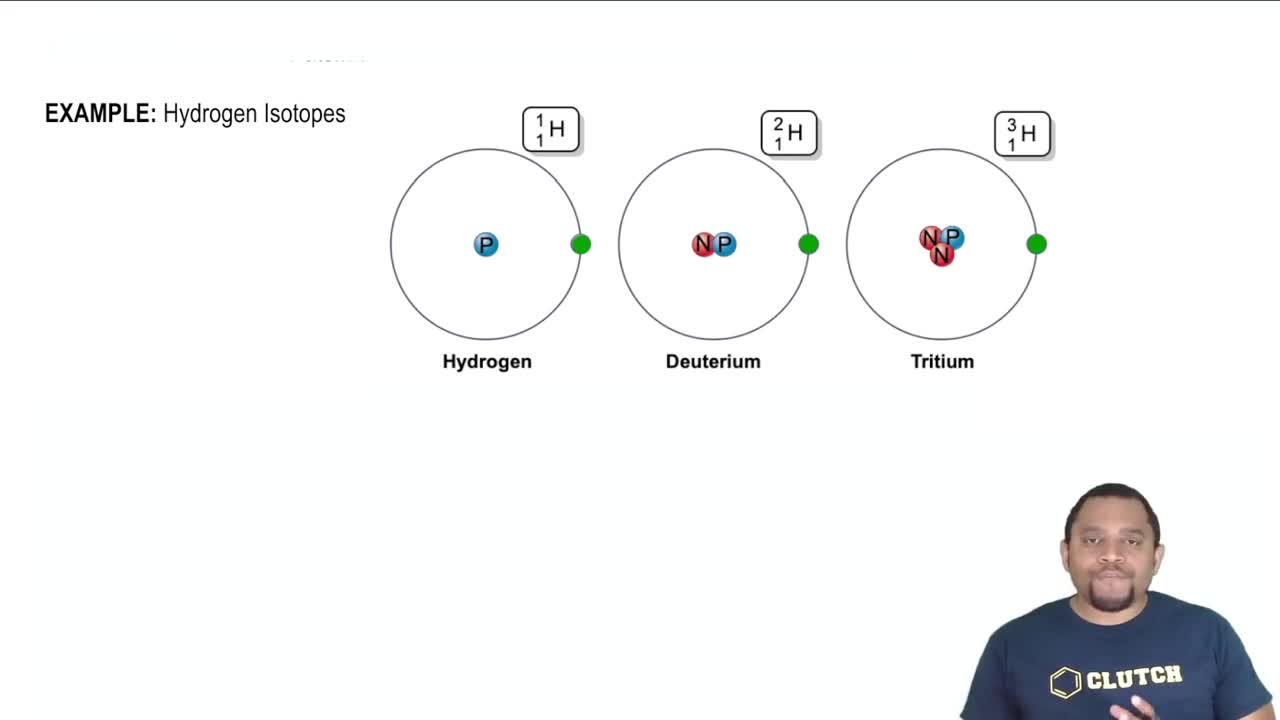
Deuterium (D) is the hydrogen isotope of mass number 2, with a proton and a neutron in its nucleus. The chemistry of deuterium is nearly identical to the chemistry of hydrogen, except that the C―D bond is slightly stronger than the C―H bond by 5.0 kJ/mol (1.2 kcal/ mol). Reaction rates tend to be slower when a C―D bond (as opposed to a C―H bond) is broken in a rate-limiting step.
This effect, called a kinetic isotope effect, is clearly seen in the chlorination of methane. Methane undergoes free-radical chlorination 12 times as fast as tetradeuteriomethane (CD4).

c. Consider the thermodynamics of the chlorination of methane and the chlorination of ethane, and use the Hammond postulate to explain why one of these reactions has a much larger isotope effect than the other.

Verified step by step guidance
1
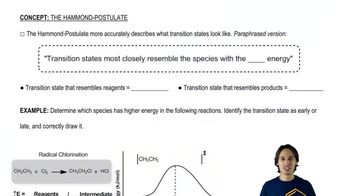
Step 1: Begin by understanding the Hammond postulate. The Hammond postulate states that the structure of the transition state in a reaction resembles the structure of the species (reactants or products) to which it is closer in energy. For an exothermic reaction, the transition state resembles the reactants, while for an endothermic reaction, it resembles the products.
Step 2: Analyze the thermodynamics of the chlorination of methane and ethane. Chlorination of methane is more exothermic compared to the chlorination of ethane because the C-H bond in methane is stronger than the C-H bond in ethane. This means that the transition state for methane chlorination is closer in structure to the reactants, while for ethane chlorination, the transition state is closer to the products.
Step 3: Consider the kinetic isotope effect (KIE). The KIE arises because breaking a C-D bond requires more energy than breaking a C-H bond. If the transition state closely resembles the reactants (as in methane chlorination), the difference in bond strength between C-H and C-D will have a larger impact on the reaction rate. This is because the bond-breaking step is more significant in determining the rate.
Step 4: Compare the reactions. In the chlorination of methane, the transition state is reactant-like due to the exothermic nature of the reaction. This makes the isotope effect more pronounced because the C-H or C-D bond is partially broken in the transition state. In contrast, for ethane chlorination, the transition state is more product-like, so the bond-breaking step has less influence on the rate, leading to a smaller isotope effect.
Step 5: Conclude that the larger isotope effect observed in methane chlorination compared to ethane chlorination is due to the Hammond postulate. The exothermic nature of methane chlorination results in a reactant-like transition state, where the difference in bond strength between C-H and C-D plays a more significant role in the reaction rate.

Verified video answer for a similar problem:

This video solution was recommended by our tutors as helpful for the problem above.
Video duration:
5m
Was this helpful?

Key Concepts

Here are the essential concepts you must grasp in order to answer the question correctly.

Kinetic Isotope Effect

The kinetic isotope effect (KIE) refers to the change in reaction rate that occurs when an atom in a molecule is replaced by one of its isotopes. In organic reactions, this effect is particularly pronounced when breaking bonds involving hydrogen isotopes, such as deuterium (D) and protium (H). The C―D bond is stronger than the C―H bond, leading to slower reaction rates when C―D bonds are involved in the rate-limiting step of a reaction.
Recommended video:
Guided course
03:06
Understanding the hydrogen isotopes.

Hammond Postulate

The Hammond postulate states that the structure of the transition state of a reaction resembles the structure of the reactants or products that are closer in energy. This principle helps predict the effects of substituents on reaction rates and can explain why reactions involving different isotopes exhibit varying kinetic behaviors. In the context of chlorination, the postulate can elucidate why the transition state for the chlorination of methane differs significantly from that of ethane, affecting the isotope effect observed.
Recommended video:
Guided course
01:30
Defining the Hammond Postulate.

Thermodynamics of Chlorination Reactions

Thermodynamics in chlorination reactions involves understanding the energy changes associated with bond breaking and forming during the reaction. The stability of the transition state and the energy difference between reactants and products influence the reaction rate. In comparing methane and ethane chlorination, the differences in bond strengths and the resulting transition state energies can explain the observed differences in kinetic isotope effects, as the more stable transition state will lead to a faster reaction.
Recommended video:
Guided course
03:
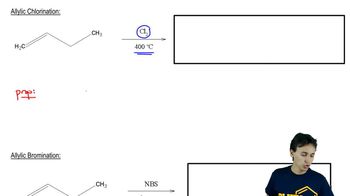
Specific Reactions - Allylic Chlorination
Related Practice
Textbook Question

When healthy, Earth’s stratosphere contains a low concentration of ozone (O3) that absorbs potentially harmful ­ultraviolet (UV) radiation by the cycle shown at right.

Chlorofluorocarbon refrigerants, such as Freon 12 (CF2Cl2), are stable in the lower atmosphere, but in the stratosphere they absorb high-energy UV radiation to generate chlorine radicals.

The presence of a small number of chlorine radicals appears to lower ozone concentrations dramatically. The following reactions are all known to be exothermic (except the one requiring light) and to have high rate constants. Propose two mechanisms to explain how a small number of chlorine ­radicals can destroy large numbers of ozone molecules. Which of the two mechanisms is more likely when the concentration of chlorine atoms is very small?

738
views
Textbook Question

Iodination of alkanes using iodine (I2) is usually an unfavorable reaction. (See Problem 4-17 , for example.) Tetraiodomethane (CI4) can be used as the iodine source for iodination in the presence of a free-radical initiator such as hydrogen peroxide. Propose a mechanism (involving mildly exothermic propagation steps) for the following proposed reaction. Calculate the value of ΔH for each of the steps in your proposed mechanism.

The following bond-dissociation energies maybe helpful:

2595
views
Textbook Question

Deuterium (D) is the hydrogen isotope of mass number 2, with a proton and a neutron in its nucleus. The chemistry of deuterium is nearly identical to the chemistry of hydrogen, except that the C―D bond is slightly stronger than the C―H bond by 5.0 kJ/mol (1.2 kcal/mol). Reaction rates tend to be slower when a C―D bond (as opposed to a C―H bond) is broken in a rate-limiting step.

This effect, called a kinetic isotope effect, is clearly seen in the chlorination of methane. Methane undergoes free-radical chlorination 12 times as fast as tetradeuteriomethane (CD4).

a. Draw the transition state for the rate-limiting step of each of these reactions, showing how a bond to hydrogen or ­deuterium is being broken in this step.

835
views
Textbook Question

Deuterium (D) is the hydrogen isotope of mass number 2, with a proton and a neutron in its nucleus. The chemistry of deuterium is nearly identical to the chemistry of hydrogen, except that the C―D bond is slightly stronger than the C―H bond by 5.0 kJ/mol (1.2 kcal/mol). Reaction rates tend to be slower when a C―D bond (as opposed to a C―H bond) is broken in a rate-limiting step.

This effect, called a kinetic isotope effect, is clearly seen in the chlorination of methane. Methane undergoes free-radical chlorination 12 times as fast as tetradeuteriomethane (CD4).

b. Monochlorination of deuterioethane (C2H5D) leads to a mixture containing 93% C2H4DCl and 7% C2H5Cl. Calculate the relative rates of abstraction per hydrogen and deuterium in the chlorination of deuterioethane.

734
views