Ch.4 - The Study of Chemical Reactions
Wade - Organic Chemistry 9th Edition
Wade9th EditionOrganic ChemistryISBN: 9780135213728Not the one you use?Change textbook
Chapter 4, Problem 8b

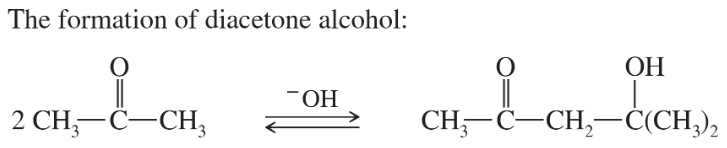
For each reaction, estimate whether ΔS° for the reaction is positive, negative, or impossible to predict.
(b)

Verified step by step guidance
1
Step 1: Understand the concept of entropy (ΔS°). Entropy is a measure of disorder or randomness in a system. A positive ΔS° indicates an increase in disorder, while a negative ΔS° indicates a decrease in disorder.
Step 2: Analyze the reaction. The formation of diacetone alcohol involves combining smaller molecules into a larger, more complex molecule. This typically results in a decrease in the number of particles in the system.
Step 3: Consider the physical states of the reactants and products. If the reactants are in a more disordered state (e.g., gases or liquids) and the product is a single, more ordered molecule, this suggests a decrease in entropy.
Step 4: Evaluate the role of the hydroxide ion (OH⁻). The hydroxide ion acts as a catalyst in this reaction, meaning it facilitates the reaction without being consumed. Its presence does not significantly affect the entropy change of the system.
Step 5: Conclude based on the above analysis. Since the reaction involves the formation of a larger molecule from smaller ones, ΔS° for the reaction is likely negative, as the system becomes more ordered.

Verified video answer for a similar problem:

This video solution was recommended by our tutors as helpful for the problem above.
Video duration:
1m
Was this helpful?

Key Concepts

Here are the essential concepts you must grasp in order to answer the question correctly.

Entropy (ΔS°)

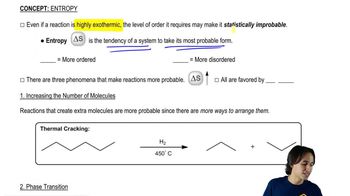
Entropy, denoted as ΔS°, is a measure of the disorder or randomness in a system. In chemical reactions, a positive ΔS° indicates an increase in disorder, while a negative ΔS° suggests a decrease in disorder. Understanding how the number of moles of gaseous products and reactants changes during a reaction is crucial for predicting the sign of ΔS°.
Recommended video:
Guided course
02:46
Explaining what entropy is.

Reaction Mechanism

The reaction mechanism describes the step-by-step process by which reactants are converted into products. In the case of diacetone alcohol formation, knowing the intermediates and the overall stoichiometry helps in assessing how the arrangement of molecules changes, which directly influences the entropy change.
Recommended video:
Guided course
02:16
Heck Reaction Mechanism

Equilibrium and Le Chatelier's Principle

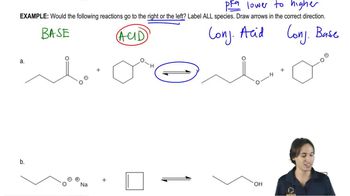
Le Chatelier's Principle states that if a system at equilibrium is disturbed, it will shift in a direction that counteracts the disturbance. This principle can help predict how changes in concentration, temperature, or pressure affect the position of equilibrium and, consequently, the entropy of the system during the formation of diacetone alcohol.
Recommended video:
Guided course
04:00
Determining Acid/Base Equilibrium