
Textbook Question
Rank the following radicals in decreasing order of stability. Classify each as primary, secondary, or tertiary.
a. The isopentyl radical,
b. The 3-methyl-2-butyl radical,
c. The 2-methyl-2-butyl radical,
d.
1388
views

 Verified step by step guidance
 10:14
10:14
 01:30
01:30 00:54
00:54Rank the following radicals in decreasing order of stability. Classify each as primary, secondary, or tertiary.
a. The isopentyl radical,
b. The 3-methyl-2-butyl radical,
c. The 2-methyl-2-butyl radical,
d.
Write an equation for the reaction of vitamin E with an oxidizing radical (RO•) to give ROH and a less reactive free radical.
Alkoxy radicals (R—O•) are generally more stable than alkyl (R•) radicals. Write an equation showing an alkyl free radical (from burning gasoline) abstracting a hydrogen atom from tert-butyl alcohol, (CH3)3COH. Explain why tert-butyl alcohol works as an antiknock additive for gasoline
Use the information in Table 4-2 to explain why toluene (PhCH3) has a very high octane rating of 111. Write an equation to show how toluene reacts with an alkyl free radical to give a relatively stable radical.
The triphenylmethyl cation is so stable that some of its salts can be stored for months. Explain why this cation is so stable.
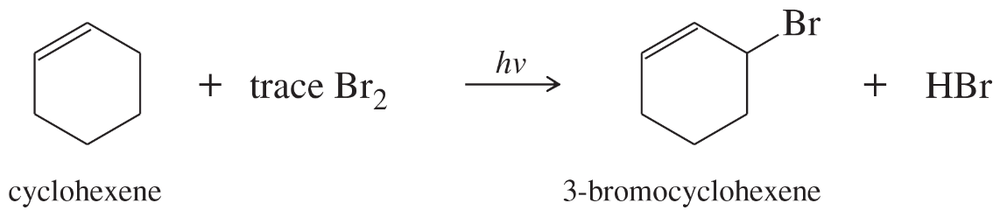
In the presence of a small amount of bromine, cyclohexene undergoes the following light-promoted reaction:
a. Propose a mechanism for this reaction.