Ch.4 - The Study of Chemical Reactions
Wade - Organic Chemistry 9th Edition
Wade9th EditionOrganic ChemistryISBN: 9780135213728Not the one you use?Change textbook
Chapter 4, Problem 11c

The reaction of tert-butyl chloride with methanol

is found to follow the rate equation
rate = kr[(CH3)3C—Cl]
c. What is the kinetic order overall

Verified step by step guidance
1
Step 1: Analyze the given rate equation, rate = Kr[(CH3)3C—Cl]. This indicates that the rate of the reaction depends only on the concentration of tert-butyl chloride ((CH3)3C—Cl).
Step 2: Recall the definition of reaction order. The reaction order is determined by the sum of the exponents of the concentration terms in the rate equation. In this case, the exponent for [(CH3)3C—Cl] is 1.
Step 3: Note that methanol (CH3OH) is present in the reaction but does not appear in the rate equation. This suggests that the reaction rate is independent of the concentration of methanol, confirming that the reaction is unimolecular.
Step 4: Recognize that this type of reaction is characteristic of an SN1 mechanism, where the rate-determining step involves the formation of a carbocation intermediate from tert-butyl chloride.
Step 5: Conclude that the overall kinetic order of the reaction is 1, as the rate depends solely on the concentration of tert-butyl chloride.

Verified video answer for a similar problem:

This video solution was recommended by our tutors as helpful for the problem above.
Video duration:
2m
Was this helpful?

Key Concepts

Here are the essential concepts you must grasp in order to answer the question correctly.

Nucleophilic Substitution Reactions

Nucleophilic substitution reactions involve the replacement of a leaving group (like Cl in tert-butyl chloride) by a nucleophile (like methanol). In this case, the reaction follows an SN1 mechanism due to the stability of the tert-butyl carbocation formed during the reaction. Understanding this mechanism is crucial for analyzing the reaction's kinetics and products.
Recommended video:
Guided course
01:47
Nucleophiles and Electrophiles can react in Substitution Reactions.

Rate Law and Kinetic Order

The rate law expresses the relationship between the rate of a chemical reaction and the concentration of its reactants. In this case, the rate equation is given as rate = Kr[(CH3)3C—Cl], indicating that the reaction is first-order with respect to tert-butyl chloride. The overall kinetic order is determined by summing the exponents in the rate law, which in this case is 1.
Recommended video:
5:07
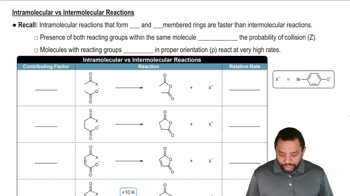
Rates of Intramolecular Reactions Concept 2

Energy Diagram

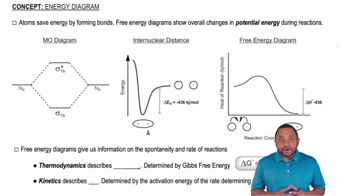
An energy diagram visually represents the energy changes during a chemical reaction, including the activation energy and the transition states. The diagram for the reaction of tert-butyl chloride with methanol would show the formation of the carbocation intermediate and the energy barrier that must be overcome for the reaction to proceed. This understanding helps in grasping the reaction's mechanism and its rate.
Recommended video:
Guided course
06:07
Introduction to free energy diagrams.