Ch.4 - The Study of Chemical Reactions
Wade - Organic Chemistry 9th Edition
Wade9th EditionOrganic ChemistryISBN: 9780135213728Not the one you use?Change textbook
Chapter 4, Problem 13b,c

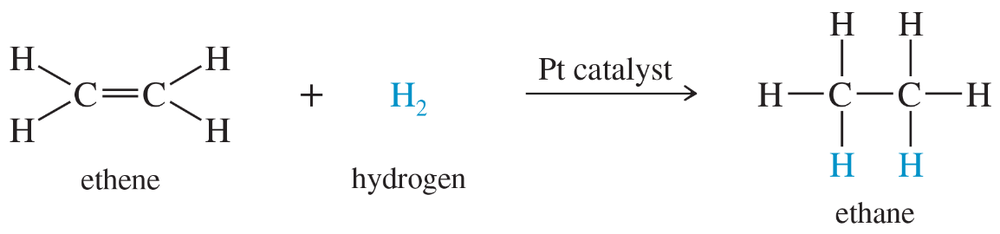
When a small piece of platinum is added to a mixture of ethene and hydrogen, the ­following reaction occurs:

Doubling the concentration of hydrogen has no effect on the reaction rate. Doubling the concentration of ethene also has no effect.
b. Write the unusual rate equation for this reaction.
c. Explain this strange rate equation, and suggest what one might do to accelerate the reaction.

Verified step by step guidance
1
Step 1: Analyze the reaction. The reaction involves the hydrogenation of ethene (C₂H₄) to ethane (C₂H₆) using hydrogen gas (H₂) in the presence of a platinum catalyst. The platinum catalyst facilitates the addition of hydrogen atoms to the double bond in ethene, converting it into a single bond in ethane.
Step 2: Understand the rate equation. The problem states that doubling the concentration of hydrogen or ethene has no effect on the reaction rate. This suggests that the reaction rate is independent of the concentrations of the reactants, which is unusual for a typical chemical reaction. The rate equation for this reaction can be written as: rate = k, where k is the rate constant.
Step 3: Explain the unusual rate equation. The independence of the reaction rate from the concentrations of ethene and hydrogen indicates that the reaction is likely limited by the surface area of the platinum catalyst. The catalyst provides active sites for the reaction, and once these sites are saturated, increasing the concentration of reactants does not increase the rate.
Step 4: Suggest a way to accelerate the reaction. To increase the reaction rate, one could increase the surface area of the platinum catalyst. This can be achieved by using finely divided platinum or a platinum catalyst supported on a porous material, which provides more active sites for the reaction.
Step 5: Summarize the findings. The reaction rate is determined by the availability of active sites on the platinum catalyst rather than the concentrations of the reactants. Enhancing the catalyst's surface area is the most effective way to accelerate the reaction.

Verified video answer for a similar problem:

This video solution was recommended by our tutors as helpful for the problem above.
Video duration:
4m
Was this helpful?

Key Concepts

Here are the essential concepts you must grasp in order to answer the question correctly.

Reaction Rate and Rate Laws

The reaction rate refers to the speed at which reactants are converted into products in a chemical reaction. Rate laws express the relationship between the concentration of reactants and the rate of the reaction. They are determined experimentally and can indicate how changes in concentration affect the rate, often represented as rate = k[A]^m[B]^n, where k is the rate constant, and m and n are the orders of the reaction with respect to reactants A and B.
Recommended video:
5:07
Rates of Intramolecular Reactions Concept 2

Catalysis

Catalysis involves the acceleration of a chemical reaction by a substance called a catalyst, which is not consumed in the reaction. In this case, platinum serves as a heterogeneous catalyst, facilitating the reaction between ethene and hydrogen without altering its own structure. Catalysts lower the activation energy required for a reaction, allowing it to proceed more quickly, but they do not change the overall stoichiometry of the reaction.
Recommended video:
2:31
Nucleophilic Catalysis Concept 1

Zero-Order Reactions

A zero-order reaction is one where the rate of reaction is independent of the concentration of the reactants. This means that even if the concentration of ethene or hydrogen is doubled, the reaction rate remains unchanged. This behavior often occurs when a catalyst is present, and the reaction is limited by the surface area of the catalyst rather than the concentration of the reactants. To accelerate a zero-order reaction, one might increase the surface area of the catalyst or increase the temperature.
Recommended video:
Guided course
01:42
Proper name ordering and punctuation