
Ch.5 - Stereochemistry
Wade - Organic Chemistry 9th Edition
Wade9th EditionOrganic ChemistryISBN: 9780135213728Not the one you use?Change textbook
Chapter 5, Problem 4a,b

For each of the stereocenters (circled) in Figure 5-5,
a. draw the compound with two of the groups on the stereocenter interchanged.
b. give the relationship of the new compound to the original compound.

Verified step by step guidance
1
Step 1: Identify the stereocenters in the given compounds. In Figure 5-5, the stereocenters are circled and marked with an asterisk (*). These are the asymmetric carbons or nitrogen atoms where four different groups are attached.
Step 2: For part (a), interchange two groups attached to each stereocenter. For example, in the first compound, interchange the positions of the bromine (Br) and hydrogen (H) atoms. Similarly, for the second compound, interchange two groups attached to the nitrogen atom, such as CH2CH2CH3 and CH(CH3)2. For the third compound, interchange two groups attached to the circled carbon atoms.
Step 3: Redraw the modified compounds after the interchange of groups. Ensure that the stereochemistry is accurately represented, including wedge and dash bonds to indicate the spatial arrangement of the groups.
Step 4: For part (b), determine the relationship between the original compound and the new compound formed after the interchange. This relationship is typically enantiomeric (mirror images) or diastereomeric (non-mirror image stereoisomers). Analyze the spatial arrangement of the groups to classify the relationship.
Step 5: Verify the stereochemical changes and confirm the relationship by considering the configuration (R/S or cis/trans) of the stereocenters before and after the interchange. This ensures the accuracy of the stereochemical relationship.

Verified video answer for a similar problem:

This video solution was recommended by our tutors as helpful for the problem above.
Video duration:
5m
Was this helpful?

Key Concepts

Here are the essential concepts you must grasp in order to answer the question correctly.

Stereocenters

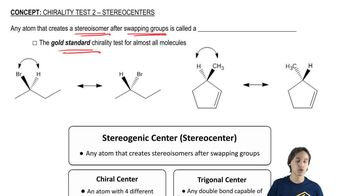
Stereocenters, or chiral centers, are atoms in a molecule that have four different substituents attached, leading to non-superimposable mirror images known as enantiomers. In organic chemistry, the presence of stereocenters is crucial for understanding the three-dimensional arrangement of atoms, which affects the compound's properties and reactivity.
Recommended video:
Guided course
02:15
What is a stereocenter?

Chirality

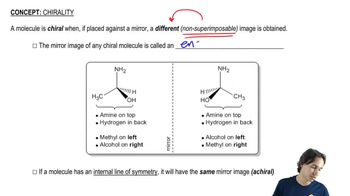
Chirality refers to the geometric property of a molecule that makes it non-superimposable on its mirror image. Molecules that possess chirality can exist as two enantiomers, which can have significantly different biological activities. Understanding chirality is essential for predicting how different isomers will interact in chemical reactions and biological systems.
Recommended video:
Guided course
05:10
What is chirality?

Interchanging Groups

Interchanging groups on a stereocenter involves swapping the positions of two substituents attached to that center, resulting in a new stereoisomer. This process is fundamental in stereochemistry, as it allows chemists to explore the relationships between different stereoisomers, such as determining whether they are enantiomers, diastereomers, or identical.
Recommended video:
Guided course
04:42
Sequence Groups
Related Practice
Textbook Question

Draw a three-dimensional structure for each compound, and star all asymmetric carbon atoms. Draw the mirror for each structure, and state whether you have drawn a pair of enantiomers or just the same molecule twice. Build molecular models of any of these examples that seem difficult to you.

(i)

943
views
Textbook Question
Make a model and draw a three-dimensional structure for each compound. Then draw the mirror image of your original structure and determine whether the mirror image is the same compound. Label each structure as being chiral or achiral, and label pairs of enantiomers.a. cis-1,2-dimethylcyclobutaneb. trans-1,2-dimethylcyclobutane
703
views
Textbook Question
Draw three-dimensional representations of the following compounds. Which have asymmetric carbon atoms? Which have no asymmetric carbons but are chiral anyway? Use your models for parts (a) through (d) and any others that seem unclear.a. ClHC═C═CHCl1,3-dichloropropadieneb. ClHC═C═CHCH31-chlorobuta-1,2-diene
1178
views
Textbook Question

Draw a three-dimensional structure for each compound, and star all asymmetric carbon atoms. Draw the mirror for each structure, and state whether you have drawn a pair of enantiomers or just the same molecule twice. Build molecular models of any of these examples that seem difficult to you.

(c)

(d) 1-bromo-2-methylbutane

2572
views
Textbook Question

Draw a three-dimensional structure for each compound, and star all asymmetric carbon atoms. Draw the mirror for each structure, and state whether you have drawn a pair of enantiomers or just the same molecule twice. Build molecular models of any of these examples that seem difficult to you

(a)

(b)

2005
views
Textbook Question
Draw a Fischer projection for each compound. Remember that the cross represents an asymmetric carbon atom, and the carbon chain should be along the vertical, with the IUPAC numbering from top to bottom.a. (S)-propane-1,2-diolb. (R)-2-bromobutan-1-ol
2777
views
1
rank