
Ch.5 - Stereochemistry
Wade - Organic Chemistry 9th Edition
Wade9th EditionOrganic ChemistryISBN: 9780135213728Not the one you use?Change textbook
Chapter 5, Problem 26g,h

For each structure,
1. star (*) any asymmetric carbon atoms.
2. label each asymmetric carbon as (R) or (S).
3. draw any internal mirror planes of symmetry.
4. label the structure as chiral or achiral.
5. label any meso structures.
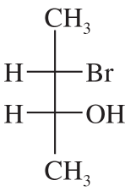
(g)
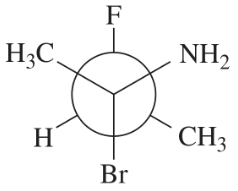
(h)

Verified step by step guidance
1
Step 1: Identify asymmetric carbon atoms in each structure. An asymmetric carbon is a carbon atom bonded to four different groups. For structure (g), examine each carbon atom to determine if it is bonded to four distinct substituents. For structure (h), repeat the process for each carbon atom.
Step 2: Mark each asymmetric carbon atom with a star (*) in both structures. For structure (g), the asymmetric carbons are the ones bonded to Br, OH, H, and CH3 groups. For structure (h), identify the asymmetric carbons based on their substituents (e.g., Br, F, NH2, CH3, H).
Step 3: Assign the configuration (R or S) to each asymmetric carbon atom using the Cahn-Ingold-Prelog priority rules. Assign priorities to the substituents based on atomic number, orient the molecule so the lowest priority group is pointing away, and determine the order of the remaining groups (clockwise for R, counterclockwise for S).
Step 4: Check for internal mirror planes of symmetry in each structure. If a structure has a plane of symmetry, it is achiral. For structure (g), examine whether the molecule has symmetry. For structure (h), check for symmetry in the tetrahedral arrangement.
Step 5: Determine if the structure is chiral or achiral and label any meso structures. A meso compound is achiral despite having asymmetric carbons due to internal symmetry. For structure (g), check if it is meso. For structure (h), determine if it is chiral or achiral based on symmetry and substituent arrangement.

Verified video answer for a similar problem:

This video solution was recommended by our tutors as helpful for the problem above.
Video duration:
9m
Was this helpful?

Key Concepts

Here are the essential concepts you must grasp in order to answer the question correctly.

Asymmetric Carbon Atoms

Asymmetric carbon atoms, or chiral centers, are carbon atoms that are bonded to four different substituents. This unique arrangement allows for the existence of non-superimposable mirror images, known as enantiomers. Identifying these centers is crucial for determining the chirality of a molecule.
Recommended video:
Guided course
01:44
The difference between atomic numbers and atomic mass.

Cahn-Ingold-Prelog Priority Rules

The Cahn-Ingold-Prelog (CIP) priority rules are used to assign the configuration of chiral centers as either (R) or (S). This system ranks the substituents attached to the chiral carbon based on atomic number, with higher atomic numbers receiving higher priority. The configuration is determined by the orientation of the substituents when the lowest priority group is positioned away from the viewer.
Recommended video:
Guided course
01:48
Why stereoisomers need their own naming system.

Chirality and Meso Compounds

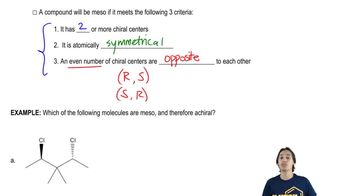
Chirality refers to the property of a molecule that is not superimposable on its mirror image, indicating that it has a distinct left and right form. Meso compounds, however, are a special case where a molecule has multiple chiral centers but is overall achiral due to an internal plane of symmetry. Recognizing these characteristics is essential for labeling structures correctly.
Recommended video:
Guided course
04:10
The 3 rules of meso compounds.
Related Practice
Textbook Question

For each structure,

1. star (*) any asymmetric carbon atoms.

2. label each asymmetric carbon as (R) or (S).

3. draw any internal mirror planes of symmetry.

4. label the structure as chiral or achiral.

5. label any meso structures.

(f)

652
views
Textbook Question

Convert the following perspective formulas to Fischer projections.

(a)

(b)

3170
views
Textbook Question

For each structure,

1. star (*) any asymmetric carbon atoms.

2. label each asymmetric carbon as (R) or (S).

3. draw any internal mirror planes of symmetry.

4. label the structure as chiral or achiral.

5. label any meso structures.

(e)

1060
views
Textbook Question

For each of the compounds described by the following names,

1. draw a three-dimensional representation.

2. star (*) each chiral center.

3. draw any planes of symmetry.

4. draw any enantiomer.

5. draw any diastereomers.

6. label each structure you have drawn as chiral or achiral.

a. (S)-2-chlorobutane

b. (R)-1,1,2-trimethylcyclohexane

956
views
Textbook Question

For each structure,

1. star (*) any asymmetric carbon atoms.

2. label each asymmetric carbon as (R) or (S).

3. draw any internal mirror planes of symmetry.

4. label the structure as chiral or achiral.

5. label any meso structures.

(a)

(b)

2663
views
1
rank
Textbook Question

For each of the compounds described by the following names,

1. draw a three-dimensional representation.

2. star (*) each chiral center.

3. draw any planes of symmetry.

4. draw any enantiomer.

5. draw any diastereomers.

6. label each structure you have drawn as chiral or achiral.

c. (2R,3S)-2,3-dibromohexane

d. (1R,2R)-1,2-dibromocyclohexane

1261
views