Ch.5 - Stereochemistry
Wade - Organic Chemistry 9th Edition
Wade9th EditionOrganic ChemistryISBN: 9780135213728Not the one you use?Change textbook
Chapter 5, Problem 5

Which of the following pairs of compounds could be separated by recrystallization or distillation?b. and

Verified step by step guidance
1
insert step 1
insert step 2
insert step 3
insert step 4
insert step 5

Verified video answer for a similar problem:

This video solution was recommended by our tutors as helpful for the problem above.
Video duration:
3m
Was this helpful?

Key Concepts

Here are the essential concepts you must grasp in order to answer the question correctly.

Recrystallization

Recrystallization is a purification technique used to separate compounds based on differences in their solubility. When a solid compound is dissolved in a hot solvent and then allowed to cool, pure crystals form as the solubility decreases. Impurities remain in the solution, allowing for the isolation of the desired compound. This method is particularly effective for compounds with similar melting points.

Distillation

Distillation is a separation process that relies on differences in boiling points of compounds. In this technique, a mixture is heated until the component with the lower boiling point vaporizes, then the vapor is cooled and condensed back into a liquid. This method is ideal for separating volatile liquids or for purifying liquids from non-volatile impurities, making it a common technique in organic chemistry.

Polarity and Solubility

Polarity refers to the distribution of electrical charge over the atoms in a molecule, influencing its solubility in various solvents. Compounds with similar polarities tend to dissolve well in each other, while those with differing polarities may not. Understanding the polarity of the compounds in question is crucial for determining the appropriate method of separation, as it affects both recrystallization and distillation outcomes.
Recommended video:
Guided course
07:13
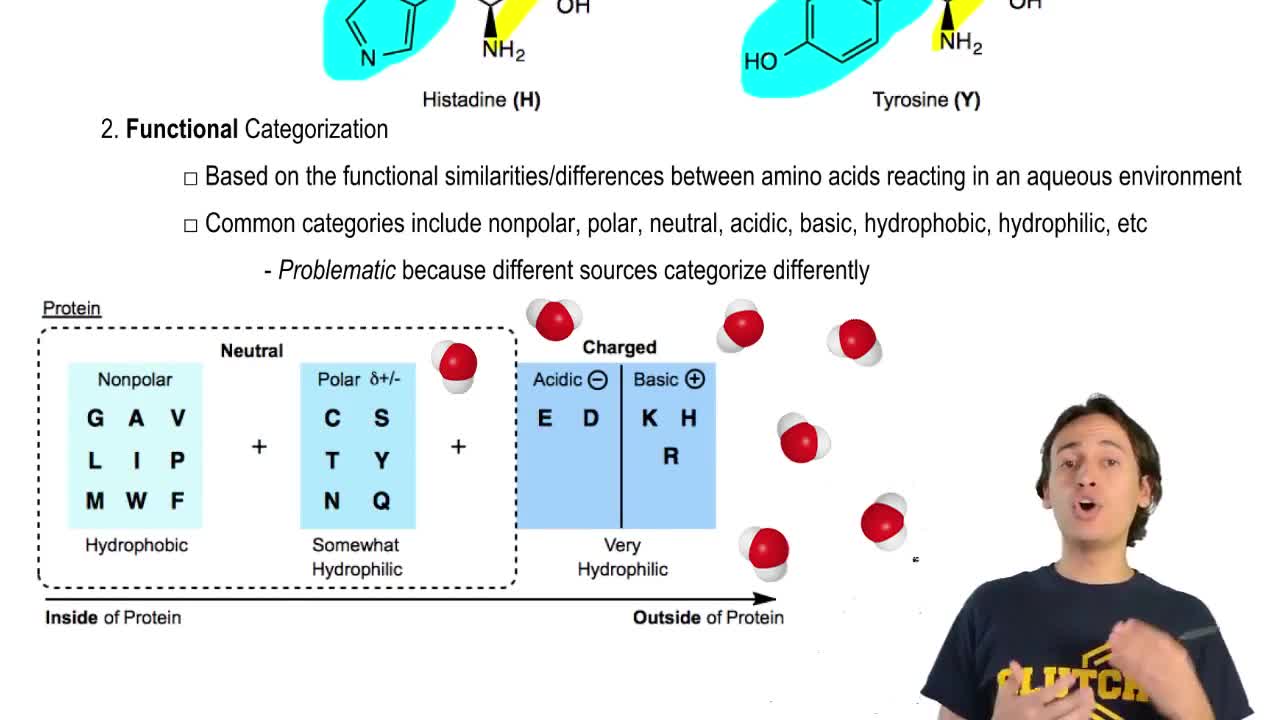
Functional Classification
Related Practice
Textbook Question
To show that (R)-2-butyl (R,R)-tartrate and (S)-2-butyl (R,R)-tartrate are not enantiomers, draw and name the mirror images of these compounds.
1038
views

Textbook Question
For each of the compounds described by the following names,1. draw a three-dimensional representation.2. star (*) each chiral center.3. draw any planes of symmetry.4. draw any enantiomer.5. draw any diastereomers.6. label each structure you have drawn as chiral or achiral.c. (2R,3S)-2,3-dibromohexaned. (1R,2R)-1,2-dibromocyclohexane
1695
views
Textbook Question

For each compound, determine whether the molecule has an internal mirror plane of symmetry. If it does, draw the mirror plane on a three-dimensional drawing of the molecule. If the molecule does not have an internal mirror plane, determine whether the structure is chiral.

(a) methane

(b) cis-1,2-dibromocyclobutane

(c) trans-1,2-dibromocyclobutane

1151
views
Textbook Question

For each compound, determine whether the molecule has an internal mirror plane of symmetry. If it does, draw the mirror plane on a three-dimensional drawing of the molecule. If the molecule does not have an internal mirror plane, determine whether the structure is chiral.

(d) 1,2-dichloropropane

(e)

1828
views
Textbook Question
For each compound, determine whether the molecule has an internal mirror plane of symmetry. If it does, draw the mirror plane on a three-dimensional drawing of the molecule. If the molecule does not have an internal mirror plane, determine whether the structure is chiral.a. Methaneb. cis-1,2-dibromocyclobutanec. trans-1,2-dibromocyclobutane
1537
views
Textbook Question

For each compound, determine whether the molecule has an internal mirror plane of symmetry. If it does, draw the mirror plane on a three-dimensional drawing of the molecule. If the molecule does not have an internal mirror plane, determine whether the structure is chiral.

(h)

862
views