
Textbook Question
Silver-assisted solvolysis of bromomethylcyclopentane in methanol gives a complex product mixture of the following five compounds. Propose mechanisms to account for these products.
(e)
230
views

 Verified step by step guidance

 09:36
09:36
 1:38
1:38 00:40
00:40Silver-assisted solvolysis of bromomethylcyclopentane in methanol gives a complex product mixture of the following five compounds. Propose mechanisms to account for these products.
(e)
Protonation converts the hydroxy group of an alcohol to a good leaving group. Suggest a mechanism for each reaction.
(b)
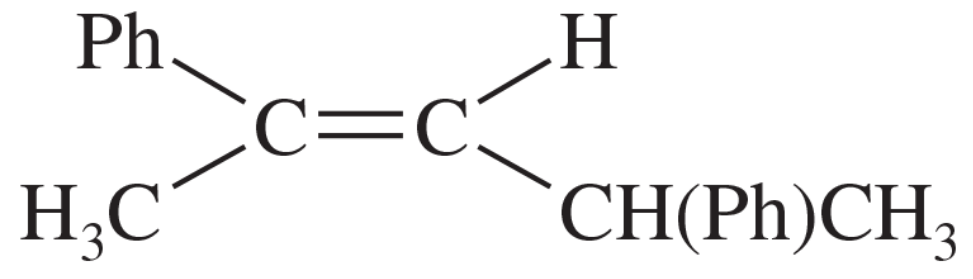
A chemist allows some pure (2S,3R)-3-bromo-2,3-diphenylpentane to react with a solution of sodium ethoxide (NaOCH2CH3) in ethanol. The products are two alkenes: A (cis-trans mixture) and B, a single pure isomer. Under the same conditions, the reaction of (2S,3S)-3-bromo-2,3-diphenylpentane gives two alkenes, A (cis-trans mixture) and C. Upon catalytic hydrogenation, all three of these alkenes (A, B, and C) give 2,3-diphenylpentane. Determine the structures of A, B, and C; give equations for their formation; and explain the stereospecificity of these reactions.
Pure (S)-2-bromo-2-fluorobutane reacts with methoxide ion in methanol to give a mixture of (S)-2-fluoro-2-methoxybutane and three fluoroalkenes.
a. Use mechanisms to show which three fluoroalkenes are formed.
Protonation converts the hydroxy group of an alcohol to a good leaving group. Suggest a mechanism for each reaction.
(a)
Pure (S)-2-bromo-2-fluorobutane reacts with methoxide ion in methanol to give a mixture of (S)-2-fluoro-2-methoxybutane and three fluoroalkenes.
b. Propose a mechanism to show how (S)-2-bromo-2-fluorobutane reacts to give (S)-2-fluoro-2-methoxybutane. Has this reaction gone with retention or inversion of configuration?