Ch. 7 - Structure and Synthesis of Alkenes; Elimination
Wade - Organic Chemistry 9th Edition
Wade9th EditionOrganic ChemistryISBN: 9780135213728Not the one you use?Change textbook
Chapter 7, Problem 40i

Draw a structure for each compound (includes old and new names).
i. (3Z,6E)-1,3,6-octatriene

Verified step by step guidance
1
Start by understanding the nomenclature: (3Z,6E)-1,3,6-octatriene. This name indicates a compound with eight carbon atoms (octa-) and three double bonds (triene). The numbers 1, 3, and 6 indicate the positions of the double bonds in the carbon chain.
The stereochemistry is specified by (3Z,6E). 'Z' (from German 'zusammen') means the highest priority groups on the double bond are on the same side, while 'E' (from German 'entgegen') means they are on opposite sides. Apply this stereochemistry to the double bonds at positions 3 and 6.
Draw the carbon backbone: Start with a linear chain of eight carbon atoms. Number them from 1 to 8 to keep track of the positions for the double bonds.
Add the double bonds: Insert double bonds between carbons 1 and 2, 3 and 4, and 6 and 7. Ensure that the double bond between carbons 3 and 4 is 'Z' and the double bond between carbons 6 and 7 is 'E'.
Complete the structure by adding hydrogen atoms to satisfy the valency of carbon. Each carbon should have four bonds. Adjust the hydrogen atoms around the double bonds to reflect the stereochemistry ('Z' and 'E') as specified.

Verified video answer for a similar problem:

This video solution was recommended by our tutors as helpful for the problem above.
Video duration:
5m
Was this helpful?

Key Concepts

Here are the essential concepts you must grasp in order to answer the question correctly.

IUPAC Nomenclature

IUPAC nomenclature is a systematic method of naming organic chemical compounds as recommended by the International Union of Pure and Applied Chemistry. It provides a standard way to name compounds so that chemists can communicate unambiguously. Understanding the rules of IUPAC nomenclature is essential for interpreting and drawing the structure of a compound from its name.
Recommended video:
Guided course
03:43
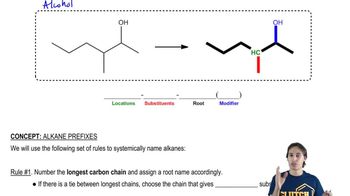
The different parts of an IUPAC name

Alkene Isomerism

Alkene isomerism refers to the existence of compounds with the same molecular formula but different structural arrangements due to the presence of double bonds. The terms 'E' and 'Z' denote the stereochemistry of alkenes, where 'E' (entgegen) indicates opposite sides and 'Z' (zusammen) indicates the same side of the double bond. Recognizing these isomers is crucial for accurately drawing the structure of alkenes.
Recommended video:
2:09
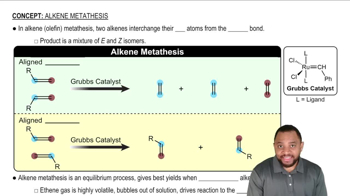
Alkene Metathesis Concept 1

Conjugated Systems

A conjugated system in organic chemistry is a system of connected p-orbitals with delocalized electrons in a molecule, which in this case involves alternating single and double bonds. Conjugation can affect the stability and reactivity of a compound. Understanding conjugated systems is important for visualizing the structure and properties of compounds like 1,3,6-octatriene.
Recommended video:
Guided course
03:27
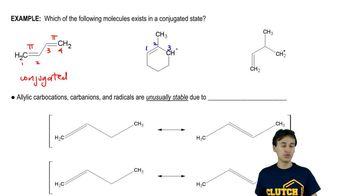
Conjugated states