Ch. 7 - Structure and Synthesis of Alkenes; Elimination
Wade - Organic Chemistry 9th Edition
Wade9th EditionOrganic ChemistryISBN: 9780135213728Not the one you use?Change textbook
Chapter 7, Problem 4a,b,c

For each of the following molecular formulas, determine the number of elements of unsaturation, and draw three examples.
a. C4H4Cl2
b. C4H8O
c. C6H8O2

Verified step by step guidance
1
Step 1: Understand the concept of elements of unsaturation. Elements of unsaturation refer to the number of pi bonds and rings in a molecule. Each double bond or ring counts as one element of unsaturation, while each triple bond counts as two.
Step 2: Use the formula for calculating elements of unsaturation: \( \text{Elements of Unsaturation} = rac{2C + 2 + N - H - X}{2} \), where \( C \) is the number of carbons, \( N \) is the number of nitrogens, \( H \) is the number of hydrogens, and \( X \) is the number of halogens (such as Cl, Br, etc.).
Step 3: Apply the formula to each molecular formula: - For \( \text{C}_4\text{H}_4\text{Cl}_2 \), substitute \( C = 4 \), \( H = 4 \), \( X = 2 \) into the formula. - For \( \text{C}_4\text{H}_8\text{O} \), substitute \( C = 4 \), \( H = 8 \), \( O = 1 \) (oxygen does not affect the calculation). - For \( \text{C}_6\text{H}_8\text{O}_2 \), substitute \( C = 6 \), \( H = 8 \), \( O = 2 \).
Step 4: Calculate the elements of unsaturation for each formula using the formula from Step 2. This will give you the number of pi bonds and/or rings present in each molecule.
Step 5: Draw three structural examples for each molecular formula that match the calculated elements of unsaturation. Consider different combinations of rings and pi bonds that satisfy the unsaturation number for each formula.

Verified video answer for a similar problem:

This video solution was recommended by our tutors as helpful for the problem above.
Video duration:
3m
Was this helpful?

Key Concepts

Here are the essential concepts you must grasp in order to answer the question correctly.

Elements of Unsaturation

Elements of unsaturation, also known as degrees of unsaturation, refer to the number of double bonds, rings, or triple bonds present in a molecule. It is calculated using the formula: (2C + 2 + N - H - X)/2, where C is the number of carbons, N is the number of nitrogens, H is the number of hydrogens, and X is the number of halogens. This concept helps in determining the structural possibilities of a given molecular formula.
Recommended video:
Guided course
02:39
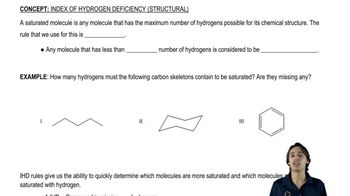
The difference between saturated and unsaturated molecules.

Molecular Formula Analysis

Analyzing a molecular formula involves understanding the composition and connectivity of atoms within a molecule. It requires identifying the types and numbers of atoms present, which aids in predicting possible structures and functional groups. This analysis is crucial for determining elements of unsaturation and drawing structural isomers.
Recommended video:
Guided course
02:17
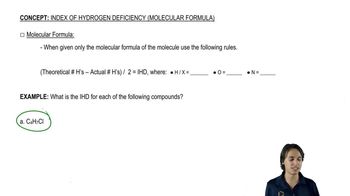
How to use IHD with molecular formula.

Structural Isomers

Structural isomers are compounds with the same molecular formula but different structural arrangements of atoms. They can vary in the connectivity of atoms, leading to different physical and chemical properties. Drawing structural isomers involves considering different ways to arrange atoms while adhering to the elements of unsaturation calculated for the given formula.
Recommended video:
Guided course
01:10
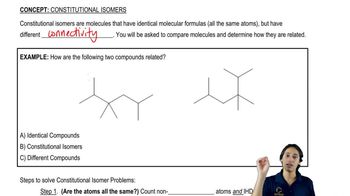
What is a constitutional isomer?