
Ch. 7 - Structure and Synthesis of Alkenes; Elimination
Wade - Organic Chemistry 9th Edition
Wade9th EditionOrganic ChemistryISBN: 9780135213728Not the one you use?Change textbook
Chapter 7, Problem 11c

For each pair of compounds, predict the one with a higher boiling point. Which compounds have zero dipole moments?
c. cyclohexene or 1,2-dichlorocyclohexene

Verified step by step guidance
1
Step 1: Understand the factors affecting boiling points. Boiling points are influenced by molecular weight, intermolecular forces (such as hydrogen bonding, dipole-dipole interactions, and van der Waals forces), and molecular structure.
Step 2: Compare the molecular weights of cyclohexene and 1,2-dichlorocyclohexene. Cyclohexene has a molecular formula of C6H10, while 1,2-dichlorocyclohexene has a molecular formula of C6H8Cl2. The presence of chlorine atoms increases the molecular weight of 1,2-dichlorocyclohexene.
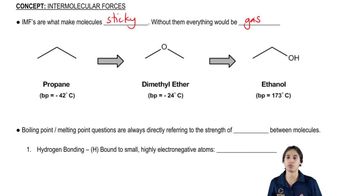
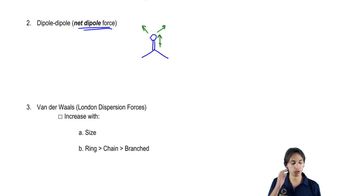
Step 3: Analyze the intermolecular forces. Cyclohexene is a non-polar molecule, primarily exhibiting van der Waals forces. 1,2-dichlorocyclohexene, due to the presence of chlorine atoms, can exhibit dipole-dipole interactions, which are stronger than van der Waals forces.
Step 4: Consider the molecular structure and symmetry. Cyclohexene is a symmetrical molecule, which contributes to a zero dipole moment. In contrast, 1,2-dichlorocyclohexene has a less symmetrical structure due to the chlorine atoms, resulting in a non-zero dipole moment.
Step 5: Predict the boiling point and dipole moment. Based on the stronger intermolecular forces and higher molecular weight, 1,2-dichlorocyclohexene is expected to have a higher boiling point than cyclohexene. Cyclohexene, being symmetrical, has a zero dipole moment.

Verified video answer for a similar problem:

This video solution was recommended by our tutors as helpful for the problem above.
Video duration:
4m
Was this helpful?

Key Concepts

Here are the essential concepts you must grasp in order to answer the question correctly.

Boiling Point and Intermolecular Forces

The boiling point of a compound is influenced by the strength of its intermolecular forces. Stronger forces, such as hydrogen bonding, dipole-dipole interactions, and London dispersion forces, result in higher boiling points. In comparing cyclohexene and 1,2-dichlorocyclohexene, consider the presence of polar bonds and molecular symmetry, which affect these forces.
Recommended video:
Guided course
03:08
How IMFs are related to melting and boiling points.

Dipole Moment

A dipole moment occurs in molecules with an uneven distribution of electron density, leading to a partial positive and negative charge. Molecules with symmetrical structures, like cyclohexene, often have zero dipole moments because the polarities cancel out. In contrast, 1,2-dichlorocyclohexene may have a dipole moment due to the presence of electronegative chlorine atoms disrupting symmetry.
Recommended video:
Guided course
01:46
How dipole-dipole forces work.

Molecular Symmetry

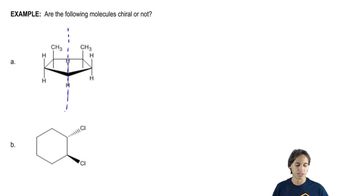
Molecular symmetry plays a crucial role in determining both boiling points and dipole moments. Symmetrical molecules tend to have lower boiling points and zero dipole moments because their symmetrical shape allows for even distribution of charge. In this context, cyclohexene is more symmetrical than 1,2-dichlorocyclohexene, affecting both its boiling point and dipole moment.
Recommended video:
Guided course
00:25
Determining Chirality with Plane of Symmetry
Related Practice
Textbook Question

Using Table 7-2 as a guide, predict which member of each pair is more stable, as well as by about how many kJ/mol or kcal/mol.

a. cis,cis-hexa-2,4-diene or trans,trans-hexa-2,4-diene

b. 2-methylbut-1-ene or 3-methylbut-1-ene

c. 2-methylbut-1-ene or 2-methylbut-2-ene

d. cis-4-methylpent-2-ene or 2-methylpent-2-ene

1333
views
Textbook Question

For each pair of compounds, predict the one with a higher boiling point. Which compounds have zero dipole moments?

b. cis- or trans-2,3-dichlorobut-2-ene

1143
views
Textbook Question

Teflon-coated frying pans routinely endure temperatures that would cause polyethylene or polypropylene to oxidize and decompose. Decomposition of polyethylene is initiated by free-radical abstraction of a hydrogen atom by O2. Bond-dissociation energies of C—H bonds are about 400 kJ/mol, and C—F bonds are about 460 kJ/mol. The BDE of the H—OO bond is about 192 kJ/mol, and the F—OO bond is about 63 kJ/mol. Show why Teflon (Figure 7-5) is much more resistant to oxidation than polyethylene is.

1208
views
Textbook Question

Explain why each of the following alkenes is stable or unstable.

(a) 1,2-dimethylcyclopentene

(b) trans-1,2-dimethylcyclopentene

(c) trans-3,4-dimethylcyclopentene

(d) trans-1,2-dimethylcyclodecene

1679
views
Textbook Question

For each pair of compounds, predict the one with a higher boiling point. Which compounds have zero dipole moments?

a. cis-1,2-dichloroethene or cis-1,2-dibromoethene

1179
views
Textbook Question

Use the data in Table 7-2 to predict the energy difference between 2,3-dimethylbut-1-ene and 2,3-dimethylbut-2-ene. Which of these double-bond isomers is more stable?

907
views