
Ch. 7 - Structure and Synthesis of Alkenes; Elimination
Wade - Organic Chemistry 9th Edition
Wade9th EditionOrganic ChemistryISBN: 9780135213728Not the one you use?Change textbook
Chapter 7, Problem 49a

Predict the products of E1 elimination of the following compounds. Label the major products.
(a) Chemical structure of a cyclohexane derivative with a bromine and two methyl groups, illustrating E1 elimination products.

Verified step by step guidance
1
Step 1: Identify the substrate and the leaving group. The given compound is a cyclohexane ring with a bromine atom (Br) as the leaving group attached to a carbon that also has two methyl groups (CH3). Bromine is a good leaving group, making this compound suitable for E1 elimination.
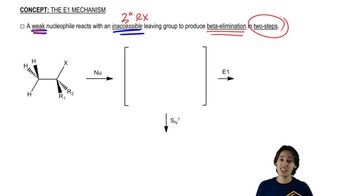
Step 2: Understand the E1 elimination mechanism. E1 elimination occurs in two steps: (1) the leaving group departs, forming a carbocation intermediate, and (2) a proton is removed from a β-carbon (adjacent to the carbocation), leading to the formation of a double bond.
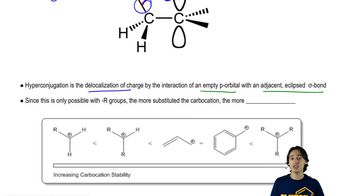
Step 3: Analyze the carbocation stability. When bromine leaves, the resulting carbocation is tertiary (attached to three carbon atoms), which is highly stable due to hyperconjugation and inductive effects. This stability favors the E1 mechanism.
Step 4: Determine the possible β-hydrogens for elimination. The β-carbons are the carbons adjacent to the carbocation. In this case, there are hydrogens on the β-carbons that can be eliminated to form double bonds. Consider the stereochemistry and regioselectivity to predict the major product.
Step 5: Apply Zaitsev's rule to predict the major product. Zaitsev's rule states that the most substituted alkene will be the major product. Elimination of a β-hydrogen from the more substituted β-carbon will result in the formation of the major product, which is the more stable alkene. Label the major product accordingly.

Verified video answer for a similar problem:

This video solution was recommended by our tutors as helpful for the problem above.
Video duration:
1m
Was this helpful?

Key Concepts

Here are the essential concepts you must grasp in order to answer the question correctly.

E1 Elimination Mechanism

The E1 elimination mechanism involves two main steps: the formation of a carbocation intermediate after the leaving group departs, followed by the removal of a proton to form a double bond. This mechanism is favored in polar protic solvents and typically occurs with tertiary or some secondary substrates due to carbocation stability.
Recommended video:
Guided course
08:09
Drawing the E1 Mechanism.

Carbocation Stability

Carbocation stability is crucial in determining the pathway of elimination reactions. Tertiary carbocations are more stable than secondary or primary ones due to hyperconjugation and inductive effects from surrounding alkyl groups. The stability influences the likelihood of the E1 mechanism occurring, as more stable carbocations are formed more readily.
Recommended video:
Guided course
05:58
Determining Carbocation Stability

Regioselectivity in Elimination Reactions

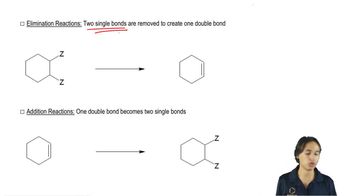
Regioselectivity refers to the preference for the formation of one constitutional isomer over others in a chemical reaction. In E1 eliminations, the major product is often the more substituted alkene, following Zaitsev's rule, which states that the more stable alkene (more substituted) is favored due to lower steric strain and greater hyperconjugation.
Recommended video:
Guided course
00:40
Recognizing Elimination Reactions.
Related Practice
Textbook Question

A double bond in a six-membered ring is usually more stable in an endocyclic position than in an exocyclic position. Hydrogenation data on two pairs of compounds follow. One pair suggests that the energy difference between endocyclic and exocyclic double bonds is about 9 kJ/mol. The other pair suggests an energy difference of about 5 kJ/mol. Which number do you trust as being more representative of the actual energy difference? Explain your answer.

4487
views
1
comments
Textbook Question

Predict the products formed by sodium hydroxide-promoted dehydrohalogenation of the following compounds. In each case, predict which will be the major product.

d. cis-1-bromo-2-methylcyclohexane

616
views
Textbook Question

For each alkene, indicate the direction of the dipole moment. For each pair, determine which compound has the larger dipole moment.

c. cis-1,2-dibromo-1,2-dichloroethene or cis-1,2-dichloroethene

835
views
Textbook Question

Predict the products formed by sodium hydroxide-promoted dehydrohalogenation of the following compounds. In each case, predict which will be the major product.

a. 1-bromobutane

b. 2-chlorobutane

c. 3-bromopentane

1041
views
Textbook Question

The energy difference between cis- and trans-but-2-ene is about 4 kJ/mol; however, the trans isomer of 4,4-dimethylpent-2-ene is nearly 16 kJ/mol more stable than the cis isomer. Explain this large difference.

2169
views
Textbook Question

Predict the products of E1 elimination of the following compounds. Label the major products.

(c)

1628
views