Ch. 7 - Structure and Synthesis of Alkenes; Elimination
Wade - Organic Chemistry 9th Edition
Wade9th EditionOrganic ChemistryISBN: 9780135213728Not the one you use?Change textbook
Chapter 7, Problem 63c

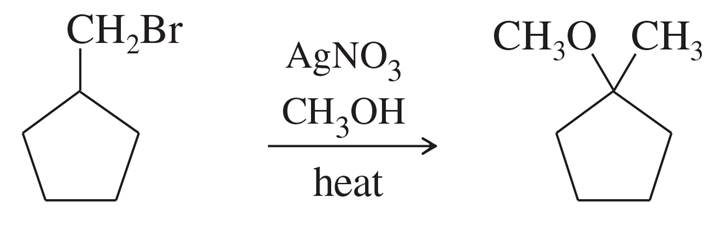
Silver-assisted solvolysis of bromomethylcyclopentane in methanol gives a complex product mixture of the following five compounds. Propose mechanisms to account for these products.
(c)

Verified step by step guidance
1
Step 1: Recognize the reaction type. The silver-assisted solvolysis of bromomethylcyclopentane in methanol involves a nucleophilic substitution reaction (SN1 mechanism) facilitated by AgNO3. Silver ion (Ag+) helps remove the bromide ion (Br−) by forming AgBr, which is insoluble and drives the reaction forward.
Step 2: Formation of the carbocation intermediate. The bromide ion leaves, forming a cyclopentylmethyl carbocation. This carbocation is stabilized by hyperconjugation and inductive effects from the cyclopentane ring.
Step 3: Consider rearrangements. The carbocation intermediate may undergo hydride or alkyl shifts to form a more stable carbocation. In this case, the cyclopentylmethyl carbocation could rearrange to form a tertiary carbocation, which is more stable.
Step 4: Nucleophilic attack by methanol. Methanol (CH3OH), acting as a nucleophile, attacks the carbocation to form an ether product. Depending on the carbocation formed, methanol can attack at different positions, leading to a mixture of products.
Step 5: Proton transfer. After methanol attacks the carbocation, a proton is transferred to stabilize the product. This step completes the formation of the ether products, which include variations depending on the carbocation rearrangements and positions of attack.

Verified video answer for a similar problem:

This video solution was recommended by our tutors as helpful for the problem above.
Video duration:
4m
Was this helpful?

Key Concepts

Here are the essential concepts you must grasp in order to answer the question correctly.

Silver-Assisted Solvolysis

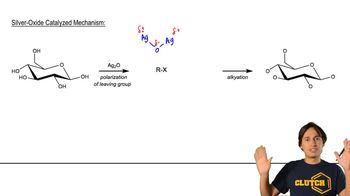
Silver-assisted solvolysis involves the use of silver salts, such as AgNO3, to facilitate the nucleophilic substitution of a leaving group (like Br) in an organic compound. In this reaction, the silver ion helps to stabilize the leaving group, promoting the formation of a carbocation intermediate, which can then react with the solvent (methanol) to form various products.
Recommended video:
Guided course
03:02
Silver Oxide Catalyzed Mechanism

Nucleophilic Substitution Mechanisms

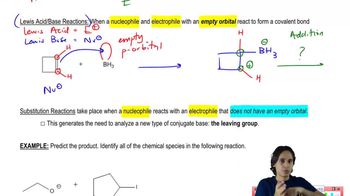
Nucleophilic substitution mechanisms, primarily SN1 and SN2, describe how nucleophiles replace leaving groups in organic molecules. SN1 involves a two-step mechanism where the leaving group departs first, forming a carbocation, followed by nucleophilic attack. In contrast, SN2 is a one-step mechanism where the nucleophile attacks the substrate simultaneously as the leaving group departs, leading to a concerted reaction.
Recommended video:
Guided course
01:47
Nucleophiles and Electrophiles can react in Substitution Reactions.

Product Mixture Formation

The formation of a complex product mixture in reactions like the one described is often due to multiple pathways available for the carbocation intermediate. Depending on the stability of the carbocation and the nature of the nucleophile (methanol in this case), various rearrangements and substitutions can occur, leading to different structural isomers and products, such as ethers and alcohols.
Recommended video:
Guided course
11:07
Bridged-Products