Ch. 7 - Structure and Synthesis of Alkenes; Elimination
Wade - Organic Chemistry 9th Edition
Wade9th EditionOrganic ChemistryISBN: 9780135213728Not the one you use?Change textbook
Chapter 7, Problem 8a,b

Some of the following examples can show geometric isomerism, and some cannot. For the ones that can, draw all the geometric isomers, and assign complete names using the E-Z system.
a. 3-bromo-2-chloropent-2-ene
b. 3-ethylhexa-2,4-diene

Verified step by step guidance
1
Identify the presence of a double bond in each compound, as geometric isomerism (cis-trans or E-Z) is possible only around double bonds.
For compound a (3-bromo-2-chloropent-2-ene), locate the double bond between the second and third carbon atoms. Check if each carbon of the double bond has two different substituents, which is necessary for geometric isomerism.
Draw the possible geometric isomers for compound a by arranging the substituents around the double bond. Use the Cahn-Ingold-Prelog priority rules to assign priorities to the substituents on each carbon of the double bond.
Assign the E or Z configuration to each isomer of compound a based on the relative positions of the highest priority substituents. E (entgegen) is when the high-priority groups are on opposite sides, and Z (zusammen) is when they are on the same side.
For compound b (3-ethylhexa-2,4-diene), identify the two double bonds. Check each double bond for the possibility of geometric isomerism by ensuring each carbon has two different substituents. Draw and assign E-Z configurations for each double bond separately, considering the priority of substituents.

Verified video answer for a similar problem:

This video solution was recommended by our tutors as helpful for the problem above.
Video duration:
6m
Was this helpful?

Key Concepts

Here are the essential concepts you must grasp in order to answer the question correctly.

Geometric Isomerism

Geometric isomerism, also known as cis-trans isomerism, occurs in compounds with restricted rotation around a bond, typically a double bond. It arises when two substituents are attached to each carbon of the double bond, allowing for different spatial arrangements. Understanding geometric isomerism is crucial for identifying and drawing isomers in organic compounds.
Recommended video:
Guided course
06:47
Monosaccharides - D and L Isomerism

E-Z Nomenclature System

The E-Z system is a method for naming geometric isomers based on the priority of substituents attached to the double-bonded carbons. 'E' (from German 'entgegen') indicates that the higher priority groups are on opposite sides, while 'Z' (from German 'zusammen') means they are on the same side. This system is essential for accurately naming and distinguishing geometric isomers.
Recommended video:
Guided course
03:48
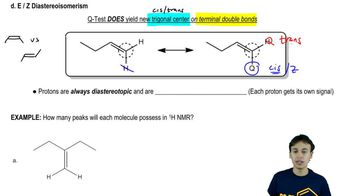
E/Z Diastereoisomerism

Priority Rules in Organic Chemistry

Priority rules, based on the Cahn-Ingold-Prelog system, determine the order of substituents for naming geometric isomers. The rules consider atomic number, connectivity, and stereochemistry to assign priority. Understanding these rules is vital for applying the E-Z nomenclature correctly and identifying the spatial arrangement of substituents in isomers.
Recommended video:
Guided course
02:24
The most important parts of the periodic table for organic chemistry